Back

Citric Acid Cycle 3 quiz

Control buttons has been changed to "navigation" mode.
1/15
  • What reaction does the alpha ketoglutarate dehydrogenase complex catalyze in the citric acid cycle?

    It converts alpha ketoglutarate to succinyl-CoA, producing NADH and releasing CO2.
  • Which cofactors are required by the alpha ketoglutarate dehydrogenase complex?

    It requires FAD, lipoate, and TPP as cofactors.
  • What substrates are used by the alpha ketoglutarate dehydrogenase complex?

    The substrates are CoA and NAD+.
  • What is the energy significance (ΔG) of the alpha ketoglutarate dehydrogenase reaction?

    It has a large negative ΔG, making it a key driving step in the citric acid cycle.
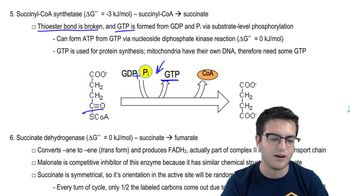
  • What type of reaction is catalyzed by succinyl-CoA synthetase?

    It catalyzes substrate-level phosphorylation, converting succinyl-CoA to succinate and generating GTP.
  • How is GTP generated in the citric acid cycle?

    GTP is generated by breaking the thioester bond in succinyl-CoA during the succinyl-CoA synthetase reaction.
  • How can GTP be converted to ATP in the cell?

    GTP can be converted to ATP by nucleoside diphosphate kinase, with no net energy cost.
  • What is a key cellular use for GTP besides energy transfer?

    GTP is important for protein synthesis, especially in mitochondria.
  • What is the function of succinate dehydrogenase in the citric acid cycle?

    It converts succinate to fumarate, producing FADH2.
  • What type of chemical bond is formed in the fumarate product of succinate dehydrogenase?

    A trans double bond is formed in fumarate.
  • What molecule acts as a competitive inhibitor of succinate dehydrogenase?

    Malonate acts as a competitive inhibitor because it closely resembles succinate.
  • Why is malonate an effective inhibitor of succinate dehydrogenase?

    Malonate is structurally similar to succinate, differing by only one CH2 group, allowing it to compete for the active site.
  • What is unique about the symmetry of succinate in the citric acid cycle?

    Succinate is symmetrical and not prochiral, so its orientation in the enzyme's active site is random.
  • How does the symmetry of succinate affect the fate of labeled carbons in the citric acid cycle?

    Because of its symmetry, only half of the labeled carbons are released per cycle, with the fraction decreasing each round.
  • What evolutionary theory is supported by the presence of mitochondrial DNA and protein synthesis machinery?

    The endosymbiotic theory, which suggests mitochondria originated as autonomous cells, is supported by these features.