Back

Citric Acid Cycle 2 quiz

Control buttons has been changed to "navigation" mode.
1/15
  • What enzyme catalyzes the first step of the citric acid cycle, and what are the substrates and product of this reaction?

    Citrate synthase catalyzes the condensation of acetyl CoA and oxaloacetate with water to form citrate.
  • Why is the reaction catalyzed by citrate synthase considered a driving step in the citric acid cycle?

    It has a highly negative ΔG, making it energetically favorable and helping to drive the cycle forward.
  • What happens to CoA during the citrate synthase reaction?

    CoA is released (bumped off) from the substrate during the formation of citrate.
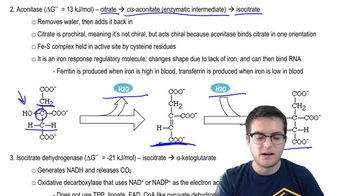
  • Which enzyme catalyzes the conversion of citrate to isocitrate, and what is notable about the ΔG of this reaction?

    Aconitase catalyzes this step, and the reaction has a ΔG close to zero under cellular conditions, making it readily reversible.
  • What is meant by citrate being 'prochiral' in the context of the citric acid cycle?

    Citrate is not actually chiral but behaves as if it were because aconitase binds it in a specific orientation, leading to a specific reaction outcome.
  • What unique structural feature does aconitase contain, and what is its role?

    Aconitase contains iron-sulfur clusters held by cysteine residues, which are important for its enzymatic activity.
  • How does aconitase participate in iron metabolism regulation?

    When iron is low, aconitase changes shape and binds RNA, regulating the expression of genes involved in iron storage and transport.
  • What proteins are produced in response to high and low iron levels, as regulated by aconitase?

    High iron induces ferritin production, while low iron induces transferrin production.
  • Which enzyme catalyzes the oxidative decarboxylation of isocitrate, and what are the products?

    Isocitrate dehydrogenase catalyzes this reaction, producing α-ketoglutarate, NADH, and CO₂.
  • What type of reaction is catalyzed by isocitrate dehydrogenase?

    It is an oxidative decarboxylation, where isocitrate is oxidized and a CO₂ is released.
  • Which cofactor is required by isocitrate dehydrogenase for its activity?

    Isocitrate dehydrogenase uses manganese as a cofactor.
  • Does isocitrate dehydrogenase use TPP, lipoate, FAD, or CoA as cofactors?

    No, isocitrate dehydrogenase does not use TPP, lipoate, FAD, or CoA, unlike some other dehydrogenases.
  • Which dehydrogenases in metabolism use TPP, lipoate, FAD, and CoA as cofactors?

    Pyruvate dehydrogenase and α-ketoglutarate dehydrogenase use these cofactors.
  • What is released as a byproduct during the isocitrate dehydrogenase reaction?

    CO₂ is released as a byproduct during the conversion of isocitrate to α-ketoglutarate.
  • Why is it important to distinguish between different dehydrogenases and their cofactor requirements?

    Not all dehydrogenases use the same cofactors, so knowing which ones do is important for understanding their mechanisms and regulation.