Back

Citric Acid Cycle 1 definitions

Control buttons has been changed to "navigation" mode.
1/15
  • Citric Acid Cycle

    A metabolic pathway that oxidizes acetyl CoA, producing energy-rich molecules and releasing carbon dioxide.
  • Acetyl CoA

    A two-carbon molecule derived from glucose, entering the cycle and combining with oxaloacetate to initiate reactions.
  • Oxaloacetate

    A four-carbon molecule that merges with acetyl CoA to form citrate, marking the cycle's starting point.
  • Citrate

    A six-carbon compound formed from acetyl CoA and oxaloacetate, serving as the cycle's first product.
  • Isocitrate

    A molecule generated from citrate, involved in a key reaction that produces NADH and carbon dioxide.
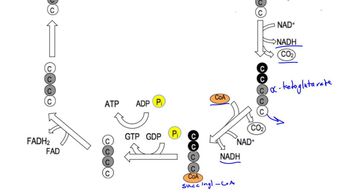
  • Alpha-Ketoglutarate

    A five-carbon intermediate formed from isocitrate, leading to NADH and carbon dioxide production.
  • Succinyl CoA

    A four-carbon compound resulting from alpha-ketoglutarate, crucial for GTP/ATP generation.
  • Succinate

    A symmetric molecule produced from succinyl CoA, causing random carbon orientation in subsequent reactions.
  • Fumarate

    A molecule formed from succinate, associated with the cycle's only FADH2 production.
  • Malate

    A compound generated from fumarate, eventually converted back to oxaloacetate to complete the cycle.
  • NADH

    An electron carrier produced at multiple steps, essential for energy generation in the electron transport chain.
  • FADH2

    A reduced coenzyme produced from succinate, contributing electrons for ATP synthesis.
  • GTP

    A nucleotide triphosphate generated via substrate-level phosphorylation, energetically equivalent to ATP.
  • Substrate-Level Phosphorylation

    A process in which a phosphate group is directly transferred to a nucleotide, forming GTP or ATP.
  • Delta G

    A thermodynamic value indicating reaction spontaneity, with negative values driving key steps in the cycle.