Back

Characteristics of Life definitions

Control buttons has been changed to "navigation" mode.
1/15
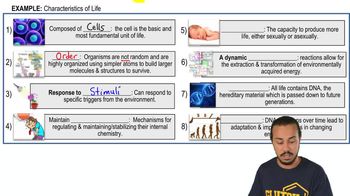
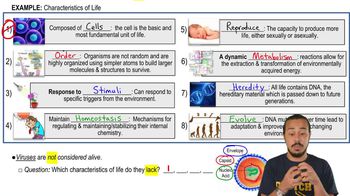
  • Cell

    Basic unit of life, forming the foundation of all living organisms and containing essential structures for survival.
  • Order

    Strategic arrangement of molecules and structures, enabling organisms to build complexity and maintain organization.
  • Stimulus

    Environmental trigger that living organisms can detect and respond to, influencing their behavior or physiology.
  • Homeostasis

    Ability to maintain stable internal conditions despite external environmental changes, ensuring survival.
  • Reproduction

    Process by which new life is generated, either sexually or asexually, ensuring continuation of a species.
  • Metabolism

    Sum of all chemical reactions within an organism, enabling energy extraction, transformation, and adaptation.
  • Heredity

    Transmission of genetic information from one generation to the next, primarily through DNA.
  • Evolution

    Gradual change in genetic material over time, leading to new traits and improved adaptation within populations.
  • Capsid

    Protein shell of a virus that encloses its genetic material, providing protection and structure.
  • Envelope

    Lipid layer surrounding some viruses, aiding in stability and sometimes in maintaining internal conditions.
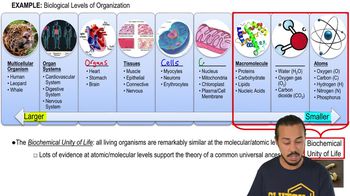
  • Macromolecule

    Large molecule composed of smaller units, essential for building cellular structures and performing biological functions.
  • Organelle

    Specialized subunit within a cell, responsible for distinct functions necessary for cellular life.
  • Tissue

    Group of similar cells working together to perform a specific function within an organism.
  • Biochemical Unity

    Resemblance among all living organisms at atomic and molecular levels, supporting the concept of a universal ancestor.
  • Universal Ancestor

    Hypothetical single origin from which all current life forms are theorized to have evolved.