Back

Biological Membrane Transport quiz

Control buttons has been changed to "navigation" mode.
1/15
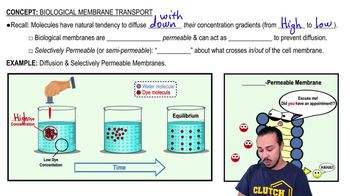
  • What is the natural tendency of molecules in terms of concentration gradients?

    Molecules naturally diffuse down their concentration gradients, moving from areas of high concentration to areas of low concentration.
  • What does it mean for a biological membrane to be selectively permeable?

    A selectively permeable membrane allows only certain molecules to cross while blocking others, based on specific properties like size, charge, and polarity.
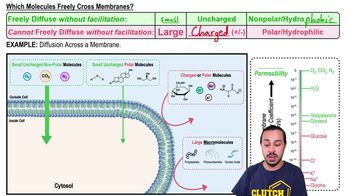
  • Which types of molecules can freely diffuse across biological membranes without facilitation?

    Small, uncharged, nonpolar, and hydrophobic molecules such as O2, CO2, and N2 can freely diffuse across membranes.
  • Why can't large, charged, or highly polar molecules freely diffuse across biological membranes?

    Large, charged, or highly polar molecules cannot freely diffuse because the membrane acts as a barrier to these properties, preventing their passage without facilitation.
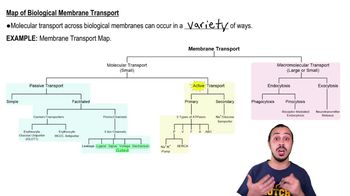
  • What is the main difference between simple diffusion and facilitated diffusion?

    Simple diffusion does not require any assistance, while facilitated diffusion requires the help of membrane proteins to transport molecules across the membrane.
  • What is the role of membrane permeability coefficient in membrane transport?

    The membrane permeability coefficient indicates how easily a molecule can cross the membrane; higher values mean higher permeability and easier diffusion.
  • How do water, steroid hormones, and glycerol cross the membrane compared to gases like O2 and CO2?

    Water, steroid hormones, and glycerol can cross the membrane but not as easily as small nonpolar gases, due to their polar groups.
  • Why do ions such as Na+, K+, and Cl- have low membrane permeability?

    Ions have low membrane permeability because their charges prevent them from passing through the hydrophobic core of the membrane without facilitation.
  • What happens to the distribution of molecules when chemical equilibrium is reached?

    At chemical equilibrium, molecules are evenly distributed throughout the available space, with no net movement in any direction.
  • What is the difference between molecular transport and macromolecular transport?

    Molecular transport involves the movement of small molecules, while macromolecular transport involves the movement of large molecules such as proteins and nucleic acids.
  • What property allows steroid hormones to cross membranes more easily than glucose?

    Steroid hormones are small and hydrophobic, allowing them to cross membranes more easily, while glucose is highly polar and cannot cross without facilitation.
  • What is the significance of the thickness of arrows in the membrane permeability diagram?

    Thicker arrows represent molecules that can cross the membrane more easily, while thinner arrows indicate less permeability and more difficulty crossing.
  • Why can't large macromolecules like proteins and polysaccharides diffuse across membranes?

    Large macromolecules are too big to squeeze between the phospholipids, so they cannot diffuse across the membrane without specialized transport mechanisms.
  • What is the main takeaway regarding the features that allow or prevent membrane diffusion?

    Small, uncharged, nonpolar, and hydrophobic molecules diffuse easily, while large, charged, polar, and hydrophilic molecules do not.
  • How is the lesson on biological membrane transport organized according to the map introduced in the video?

    The lesson is organized by first exploring molecular transport of small molecules, then passive transport (simple and facilitated), followed by active transport, and finally macromolecular transport.