Back

Carbohydrates definitions

Control buttons has been changed to "navigation" mode.
1/15
  • Carbohydrate

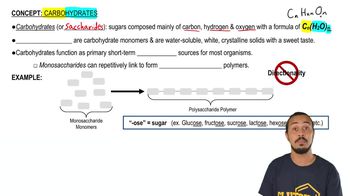
    Organic molecule composed of carbon, hydrogen, and oxygen in a ratio resembling hydrated carbon; serves as energy source and structural component.
  • Saccharide

    General term for sugar molecules, including simple and complex forms; fundamental unit in carbohydrate chemistry.
  • Monosaccharide

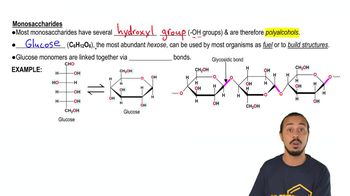
    Smallest sugar unit, water-soluble, sweet, crystalline; acts as a building block for larger carbohydrate polymers.
  • Polysaccharide

    Large carbohydrate polymer formed by linking monosaccharides; lacks directionality and serves energy storage or structural roles.
  • Glycosidic Bond

    Covalent linkage connecting monosaccharide units in carbohydrate polymers, enabling formation of complex sugars.
  • Glucose

    Six-carbon sugar, most abundant hexose; exists in linear and cyclic forms and is vital for energy and structural functions.
  • Hexose

    Sugar molecule containing six carbon atoms; includes glucose and is a key component in biological energy processes.
  • Hydroxyl Group

    Functional group with oxygen and hydrogen; present in sugars, contributing to solubility and reactivity.
  • Starch

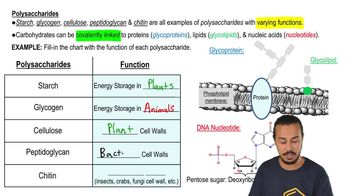
    Polysaccharide used for energy storage in plants; composed of linked glucose units.
  • Glycogen

    Polysaccharide serving as energy storage in animals; highly branched structure of glucose units.
  • Cellulose

    Structural polysaccharide forming plant cell walls; provides rigidity and support.
  • Peptidoglycan

    Structural polysaccharide found in bacterial cell walls; confers strength and protection.
  • Chitin

    Structural polysaccharide present in insect and crab shells, as well as fungal cell walls.
  • Glycoprotein

    Complex molecule with carbohydrate chains attached to a protein; involved in cell structure and signaling.
  • Glycolipid

    Molecule consisting of carbohydrate chains linked to lipids; plays a role in membrane structure and recognition.