Back

Amino Acids and Henderson-Hasselbalch definitions

Control buttons has been changed to "navigation" mode.
1/13
  • Amino Acid

    Organic molecule containing ionizable groups, each of which can independently interact with solution pH and pKa.
  • Henderson-Hasselbalch Equation

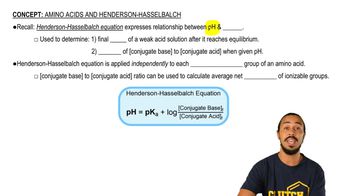
    Mathematical formula relating solution pH to pKa and the ratio of conjugate base to conjugate acid concentrations.
  • pH

    Numerical measure of solution acidity, determined by the equilibrium between ionizable groups and their conjugate forms.
  • pKa

    Value indicating the strength of an ionizable group, used to predict its protonation state at a given pH.
  • Ionizable Group

    Functional component of a molecule capable of gaining or losing protons, affecting net charge and equilibrium.
  • Conjugate Base

    Species formed when an ionizable group loses a proton, influencing the ratio used in equilibrium calculations.
  • Conjugate Acid

    Species resulting from an ionizable group retaining a proton, used in determining solution pH via equilibrium.
  • Equilibrium

    State where concentrations of acid and base forms remain constant, allowing calculation of final pH.
  • Net Charge

    Sum of charges from all ionizable groups in a molecule, determined by their protonation states at a specific pH.
  • Weak Acid

    Substance that partially dissociates in solution, requiring equilibrium calculations to determine pH.
  • Concentration

    Amount of a specific chemical species in solution, used in the ratio for the Henderson-Hasselbalch equation.
  • Logarithm

    Mathematical function applied to the ratio of base to acid concentrations in the Henderson-Hasselbalch equation.
  • Practice Problem

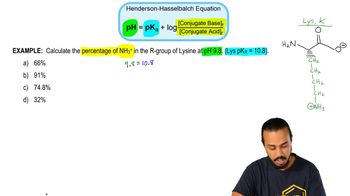
    Example scenario used to apply concepts such as pH calculation and net charge determination for amino acids.