Back

Amino Acid Oxidation 2 quiz

Control buttons has been changed to "navigation" mode.
1/15
  • What is the main amino acid used by most tissues to transport nitrogen to the liver for the urea cycle?

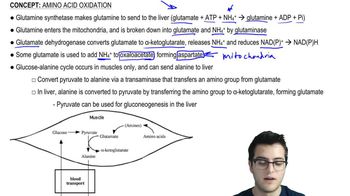
    Glutamine is the main amino acid used by most tissues to transport nitrogen to the liver.
  • Which enzyme synthesizes glutamine from glutamate, ATP, and a nitrogen group?

    Glutamine synthetase synthesizes glutamine from glutamate, ATP, and a nitrogen group.
  • What enzyme breaks down glutamine into glutamate and ammonium in the mitochondria?

    Glutaminase breaks down glutamine into glutamate and ammonium in the mitochondria.
  • What is the role of glutamate dehydrogenase in amino acid oxidation?

    Glutamate dehydrogenase removes the amino group from glutamate, producing alpha-ketoglutarate and ammonium.
  • How is aspartate formed in the mitochondria for the urea cycle?

    Aspartate is formed by transferring an amino group from glutamate to oxaloacetate.
  • What is the glucose-alanine cycle and where does it primarily occur?

    The glucose-alanine cycle is the process by which muscles send alanine to the liver, where it is converted back to pyruvate for gluconeogenesis.
  • How does alanine contribute to the urea cycle after arriving in the liver?

    Alanine is converted to pyruvate, transferring its amino group to alpha-ketoglutarate to form glutamate, which then provides nitrogen for the urea cycle.
  • What happens to the pyruvate produced from alanine in the liver?

    The pyruvate can be used for gluconeogenesis to produce glucose, which is then sent back to the muscles.
  • How are the urea cycle and citric acid cycle interconnected?

    They are interconnected through fumarate and argininosuccinate, with fumarate entering the citric acid cycle.
  • What is the function of transaminases in amino acid metabolism?

    Transaminases transfer amino groups between amino acids and keto acids, facilitating nitrogen movement.
  • Why can transaminase levels in the blood indicate tissue damage?

    Elevated transaminase levels in the blood suggest tissue damage because these enzymes leak out of damaged cells.
  • Which transaminases are commonly used as indicators of liver damage?

    GPT (ALT) and GOT (AST) are commonly used as indicators of liver damage.
  • What molecule allosterically activates carbamoyl phosphate synthetase in the urea cycle?

    N-acetylglutamate allosterically activates carbamoyl phosphate synthetase.
  • How is N-acetylglutamate synthesized and what stimulates its production?

    N-acetylglutamate is synthesized from acetyl-CoA and glutamate by N-acetylglutamate synthase, which is stimulated by arginine.
  • Why does arginine stimulate the urea cycle?

    Arginine stimulates the urea cycle because its abundance signals high nitrogen levels, prompting increased urea production to remove excess nitrogen.