Back

Amino Acid Hydrolysis definitions

Control buttons has been changed to "navigation" mode.
1/14
  • Peptide Bond

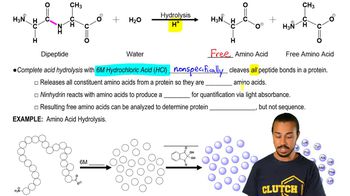
    A linkage connecting amino acid residues in proteins, broken during hydrolysis to release individual amino acids.
  • Dipeptide

    A molecule composed of two amino acid residues joined by a single peptide bond.
  • Acid Catalyst

    A substance, such as H+, used to accelerate the hydrolysis of peptide bonds in proteins.
  • 6 Molar Hydrochloric Acid

    A strong acid solution used to achieve complete hydrolysis of proteins, breaking all peptide bonds.
  • Amino Acid Residue

    A component of a protein, released as a free molecule after peptide bond cleavage.
  • Ninhydrin

    A chemical reagent that reacts with free amino acids to produce a bluish-purple color for quantification.
  • Spectrophotometer

    An instrument used to measure light absorbance, enabling quantification of amino acids after ninhydrin reaction.
  • Mass Spectrometry

    An analytical technique used to determine the amino acid composition of hydrolyzed proteins.
  • High-Performance Liquid Chromatography

    A method for separating and analyzing amino acids released from protein hydrolysis.
  • Amino Group

    A functional group found at the N-terminal end of proteins, present in free amino acids after hydrolysis.
  • Carboxyl Group

    A functional group located at the C-terminal end of proteins, also found in free amino acids post-hydrolysis.
  • Protein Composition

    The types and quantities of amino acids present in a protein, revealed after complete hydrolysis.
  • Sequence

    The specific order of amino acid residues in a protein, lost after hydrolysis with strong acid.
  • Aqueous Solution

    A water-based environment where proteins are typically hydrolyzed, facilitating peptide bond cleavage.