Back

Alpha Helix Pitch and Rise quiz

Control buttons has been changed to "navigation" mode.
1/15
  • What is the alpha helix pitch and what does it represent?

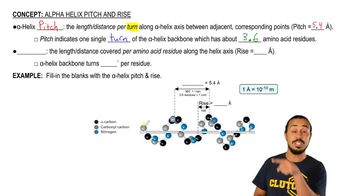
    The alpha helix pitch is the length or distance per turn along the alpha helix axis, and it measures 5.4 angstroms.
  • How many amino acid residues are found in one turn of the alpha helix?

    There are 3.6 amino acid residues in one turn of the alpha helix.
  • What is the unit of measurement for the alpha helix pitch?

    The pitch is measured in angstroms, where 1 angstrom equals 10^-10 meters.
  • How many degrees does the alpha helix backbone rotate per turn?

    The backbone rotates 360 degrees per turn.
  • What is the alpha helix rise and how is it calculated?

    The rise is the distance covered per amino acid residue along the helix axis, calculated by dividing the pitch (5.4 angstroms) by the number of residues per turn (3.6), resulting in 1.5 angstroms.
  • How much does the alpha helix backbone rotate per amino acid residue?

    The backbone rotates 100 degrees per amino acid residue.
  • What formula is used to calculate the length of an alpha helix?

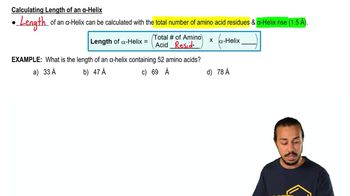
    The length is calculated by multiplying the total number of amino acid residues by the alpha helix rise (1.5 angstroms).
  • If an alpha helix contains 52 amino acids, what is its length?

    Its length is 52 times 1.5 angstroms, which equals 78 angstroms.
  • What does the alpha helix axis represent in the structure?

    The alpha helix axis is the central line along which the helix coils and measurements like pitch and rise are taken.
  • Why are R groups excluded in the backbone image when discussing pitch and rise?

    R groups are excluded to focus solely on the backbone structure and its spatial properties.
  • What is the significance of the 360-degree rotation in the alpha helix?

    A 360-degree rotation corresponds to one complete turn of the alpha helix backbone.
  • How do you determine the rise per residue from the pitch and number of residues per turn?

    Divide the pitch (5.4 angstroms) by the number of residues per turn (3.6) to get the rise (1.5 angstroms).
  • What is the relationship between pitch and rise in the alpha helix?

    Pitch is the distance per turn, while rise is the distance per residue; rise is calculated by dividing pitch by the number of residues per turn.
  • How many degrees of rotation are associated with each amino acid residue in the alpha helix?

    Each residue is associated with a 100-degree rotation of the backbone.
  • What information do you need to calculate the length of an alpha helix?

    You need the total number of amino acid residues and the alpha helix rise (1.5 angstroms per residue).