Skip to main content
Beginning & Intermediate Algebra
My Course
Learn
AI Tutor
Study Guides
Flashcards
Explore
Try the app
My Course
Learn
AI Tutor
Study Guides
Flashcards
Explore
Try the app
Back
The Multiplication and Division Properties of Equality quiz
You can tap to flip the card.
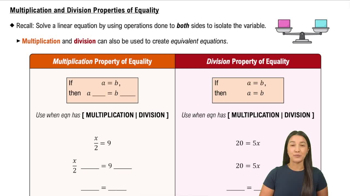
What does the multiplication property of equality state?
You can tap to flip the card.
👆
What does the multiplication property of equality state?
If a = b, then a times c = b times c for any value c.
Track progress
Control buttons has been changed to "navigation" mode.
1/15
Related flashcards
Recommended videos
The Multiplication and Division Properties of Equality definitions
The Multiplication and Division Properties of Equality
15 Terms
03:56
Multiplication Property for Fraction Coefficients
06:42
Multiplication and Division Properties of Equality
01:22
Multiplication and Division Properties of Equality Example 2
1
views
Terms in this set (15)
Hide definitions
What does the multiplication property of equality state?
If a = b, then a times c = b times c for any value c.
When should you use the multiplication property of equality when solving equations?
Use it when your equation has division and you want to cancel it out to isolate the variable.
How do you isolate x in the equation x/2 = 9?
Multiply both sides by 2 to get x = 18.
What does the division property of equality state?
If a = b, then a divided by c = b divided by c for any nonzero value c.
When should you use the division property of equality?
Use it when your equation has multiplication and you want to cancel it out to isolate the variable.
How do you solve 20 = 5x for x?
Divide both sides by 5 to get x = 4.
Why must you perform the same operation on both sides of an equation?
To keep the equation balanced and maintain equality.
What is the first step in solving 3a - 4 = 11?
Add 4 to both sides to isolate the variable term, giving 3a = 15.
After isolating the variable term in 3a = 15, what is the next step?
Divide both sides by 3 to solve for a, resulting in a = 5.
How can you check your solution to a linear equation?
Plug the solution back into the original equation to see if it creates a true statement.
How do you solve an equation with a fractional coefficient, like (3/4)x = 9?
Multiply both sides by the reciprocal of the fraction, which is 4/3, to isolate x.
What is the reciprocal of 3/4?
The reciprocal of 3/4 is 4/3.
What is the solution to (3/4)x = 9?
x = 12, after multiplying both sides by 4/3.
How do you solve 10 = (5/3)y for y?
Multiply both sides by the reciprocal 3/5 to get y = 6.
Why is understanding reciprocals important when solving equations with fractional coefficients?
Multiplying by the reciprocal cancels the fraction, making it easier to isolate the variable.
 BackBack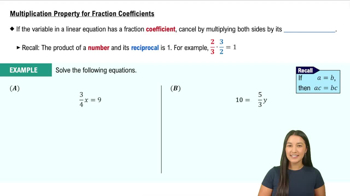
 03:56
03:56