Skip to main content
Beginning & Intermediate Algebra
My Course
Learn
AI Tutor
Study Guides
Flashcards
Explore
Try the app
My Course
Learn
AI Tutor
Study Guides
Flashcards
Explore
Try the app
Back
The Addition and Subtraction Properties of Equality definitions
You can tap to flip the card.
Linear Equation
You can tap to flip the card.
👆
Linear Equation
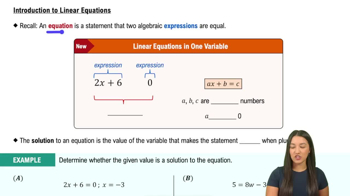
An algebraic statement with a variable of degree one and real coefficients, always expressible in the form ax+b=c.
Track progress
Control buttons has been changed to "navigation" mode.
1/15
Related flashcards
Recommended videos
The Addition and Subtraction Properties of Equality quiz
The Addition and Subtraction Properties of Equality
15 Terms
01:58
Addition and Subtraction Properties of Equality Example 3
1
views
06:06
Introduction to Linear Equations
01:46
Introduction to Linear Equations Example 1
Terms in this set (15)
Hide definitions
Linear Equation
An algebraic statement with a variable of degree one and real coefficients, always expressible in the form ax+b=c.
Variable
A symbol, often a letter, representing an unknown value in an equation, which can be isolated to solve the equation.
Coefficient
A real number multiplying a variable in an algebraic expression, determining the variable's rate of change.
Constant
A fixed value in an equation or expression that does not change, often added or subtracted from a variable term.
Solution
A value for the variable that, when substituted, makes the equation a true statement.
Solution Set
A collection of all values that satisfy an equation, typically written inside curly brackets.
Equivalent Equations
Equations that have the same solution, often formed by performing the same operation on both sides.
Addition Property of Equality
A principle stating that adding the same value to both sides of an equation preserves equality.
Subtraction Property of Equality
A principle stating that subtracting the same value from both sides of an equation preserves equality.
Balance Scale
A visual analogy for equations, illustrating that both sides must remain equal when operations are performed.
First Degree Equation
An equation where the variable has an exponent of one, indicating linearity.
Opposite Operations
Pairs of mathematical actions, such as addition and subtraction, used to cancel each other when solving equations.
Curly Brackets
Symbols used to enclose solution sets, indicating all values that solve an equation.
Standard Form
A way of writing linear equations as ax+b=c, with variables and constants clearly separated.
Algebraic Expression
A mathematical phrase containing variables, coefficients, and constants, but lacking an equality sign.
 BackBack
 01:58
01:58