Beginning & Intermediate Algebra
My Course
Learn
AI Tutor
Study Guides
Flashcards
Explore
Try the app
My Course
Learn
AI Tutor
Study Guides
Flashcards
Explore
Try the app
Back
Properties of Logarithms definitions
You can tap to flip the card.
Logarithm
You can tap to flip the card.
👆
Logarithm
Represents an exponent indicating the power to which a base must be raised to produce a given number.
Track progress
Control buttons has been changed to "navigation" mode.
1/28
Related flashcards
Recommended videos
Properties of Logarithms quiz
Properties of Logarithms
15 Terms
04:41
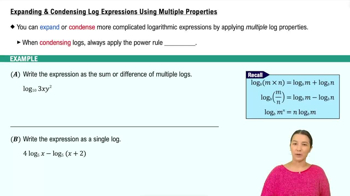
Expanding & Condensing Log Expressions Using Multiple Properties
1
views
00:48
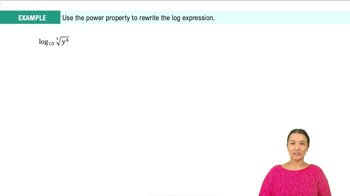
Power Property of Logs Example 2
1
views
07:17
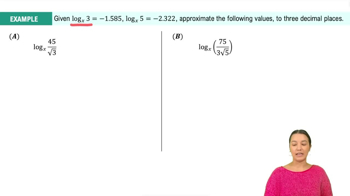
Expanding & Condensing Log Expressions Using Multiple Properties Example 3
1
views
Terms in this set (28)
Hide definitions
Logarithm
Represents an exponent indicating the power to which a base must be raised to produce a given number.
Base
The fixed number in a logarithmic expression that is raised to a power to yield the argument.
Argument
The value inside a logarithmic function, which the base is raised to in order to produce.
Product Property
Allows rewriting a log of a product as the sum of logs with the same base.
Quotient Property
Permits expressing a log of a quotient as the difference of logs with the same base.
Power Property
Enables moving an exponent in the argument to the front as a multiplier of the log.
Expansion
Process of rewriting a single log as a sum or difference of multiple logs using log properties.
Condensation
Combining multiple logs with the same base into a single log using log properties.
Exponent
Indicates how many times the base is multiplied by itself in a logarithmic or exponential expression.
Sum
Result of adding two or more logs, often produced by the product property.
Difference
Result of subtracting one log from another, typically from the quotient property.
Multiplication
Operation inside a log's argument that triggers the product property for expansion.
Division
Operation inside a log's argument that triggers the quotient property for expansion.
Exponent Rule
Guides rewriting roots and fractions as powers for easier application of log properties.
Square Root
A radical expression often rewritten as a fractional exponent for use with log properties.
Fraction
A ratio in a log's argument, commonly rewritten with negative exponents for property application.
Negative Exponent
Indicates reciprocal in a log's argument, useful for applying the power property.
Rational Exponent
Fractional power in a log's argument, often used to represent roots for property application.
Same Base
Requirement for combining or condensing logs using product or quotient properties.
Addition
Operation outside the log, resulting from expanding multiplication in the argument.
Subtraction
Operation outside the log, resulting from expanding division in the argument.
Single Log
A logarithmic expression with one log, often the result of condensing multiple logs.
Multiple Logs
Several logs with the same base, often expanded from a single log using properties.
Log Expression
An algebraic statement involving logarithms, subject to expansion or condensation.
Simplification
Process of rewriting log expressions using properties to achieve a more concise or expanded form.
Mistake
Common error such as misapplying properties to addition or subtraction inside a log's argument.
Direction
Refers to expanding or condensing logs, depending on whether properties are applied forward or reverse.
Property
A rule governing how logarithmic expressions can be rewritten for simplification or expansion.