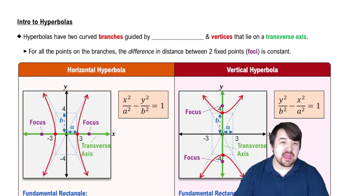
A conic section with two curved branches opening away from each other, distinguished by a minus sign in its standard equation.
Conic Section
A shape formed by the intersection of a plane and a cone, including circles, ellipses, parabolas, and hyperbolas.
Branch
One of the two separate curved parts of a hyperbola, each extending away from the center along the transverse axis.
Standard Form
An equation format for hyperbolas showing squared terms divided by constants, separated by a minus sign and set equal to one.
Transverse Axis
The axis along which the vertices of a hyperbola lie, determined by the leading squared term in the equation.
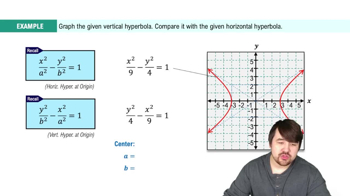
Horizontal Hyperbola
A hyperbola with branches opening left and right, indicated by the x-squared term leading in its equation.
Vertical Hyperbola
A hyperbola with branches opening up and down, indicated by the y-squared term leading in its equation.
Asymptote
A line that guides the direction of hyperbola branches, approaching but never touching them, drawn through the rectangle's diagonals.
Vertex
A point where a hyperbola's branch crosses the transverse axis, marking the closest approach to the center.
Center
The midpoint of a hyperbola, found at (h, k) in shifted equations, serving as the reference for graphing.
Fundamental Rectangle
A rectangle constructed from the center, using a and b values, whose diagonals determine the asymptotes for graphing.
Orientation
The direction in which a hyperbola opens, determined by whether x-squared or y-squared leads in the equation.
Equation
A mathematical expression representing a hyperbola, typically involving squared terms and a minus sign.
Foci
Two fixed points inside a hyperbola; the difference in distances from any point on the branches to these points remains constant.
Difference of Distances
A constant value for all points on a hyperbola, calculated between the two foci.
a Value
The distance from the center to each vertex along the transverse axis, found by taking the square root of the denominator under the leading squared term.
b Value
The distance from the center to the rectangle's sides perpendicular to the transverse axis, found by taking the square root of the other denominator.
Ellipse
A conic section similar to a hyperbola but with a plus sign in its standard equation, resulting in a closed curve.
Shifted Equation
A hyperbola equation where x and y are replaced by (x-h) and (y-k), indicating the center is not at the origin.
Origin
The point (0,0) on a graph, often used as the default center for hyperbolas in unshifted equations.
 Back
Back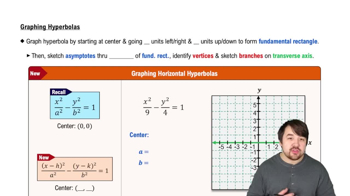
 05:43
05:43