Skip to main content
Beginning & Intermediate Algebra
My Course
Learn
AI Tutor
Study Guides
Flashcards
Explore
Try the app
My Course
Learn
AI Tutor
Study Guides
Flashcards
Explore
Try the app
Back
Graphing Quadratic Equations definitions
You can tap to flip the card.
Quadratic Equation
You can tap to flip the card.
👆
Quadratic Equation
An expression in the form y = ax² + bx + c, where a is not zero, creating a U-shaped graph.
Track progress
Control buttons has been changed to "navigation" mode.
1/29
Related flashcards
Recommended videos
Graphing Quadratic Equations quiz
Graphing Quadratic Equations
15 Terms
04:10
Intro to Graphing Quadratic Equations
04:04
Vertex Form of Quadratics Example 4
03:42
Horizontal and Vertical Shifts of Quadratics Example 2
1
views
Terms in this set (29)
Hide definitions
Quadratic Equation
An expression in the form y = ax² + bx + c, where a is not zero, creating a U-shaped graph.
Parabola
A smooth, U-shaped curve representing the graph of a quadratic equation.
Vertex
The highest or lowest point on a parabola, indicating its maximum or minimum value.
Axis of Symmetry
A vertical line dividing a parabola into two mirror-image halves, passing through the vertex.
Standard Form
The format y = ax² + bx + c for quadratic equations, useful for applying the quadratic formula.
Vertex Form
The format y = a(x-h)² + k, making it easy to identify the vertex and graph shifts.
Coefficient
A numerical factor multiplying a variable, such as a, b, or c in quadratic equations.
Intercept
A point where the graph crosses the x-axis or y-axis, indicating zero values for one variable.
X Intercept
A point where the parabola crosses the x-axis, found by setting y to zero.
Y Intercept
A point where the parabola crosses the y-axis, found by setting x to zero.
Discriminant
The expression b² - 4ac, determining the number of x intercepts for a quadratic graph.
Horizontal Shift
A movement of the parabola left or right, controlled by the value h in vertex form.
Vertical Shift
A movement of the parabola up or down, controlled by the value k in vertex form.
Vertical Stretch
A transformation making the parabola narrower, caused by a coefficient greater than one.
Vertical Compression
A transformation making the parabola wider, caused by a coefficient between -1 and 1.
Direction
The way the parabola opens, upward for positive a, downward for negative a.
Square Root Property
A method for solving equations involving squared terms, useful for finding intercepts.
Quadratic Formula
An equation providing solutions for ax² + bx + c = 0, revealing x intercepts and symmetry.
Symmetry
A feature where the parabola's left and right sides are mirror images across the axis.
Maximum
The highest value of a parabola, occurring at the vertex when a is negative.
Minimum
The lowest value of a parabola, occurring at the vertex when a is positive.
Input Value
A value substituted for x in the equation to generate corresponding output values.
Output Value
A value produced for y after substituting x into the quadratic equation.
Continuous Curve
A smooth, unbroken line representing the graph of a quadratic equation.
Intercept Formula
A calculation for finding where the graph crosses axes, using substitutions for x or y.
Width
The measure of how wide or narrow a parabola appears, determined by the coefficient a.
U Shape
The characteristic form of a parabola, opening upward or downward.
Mirror Image
The identical appearance of the parabola's sides across the axis of symmetry.
Solution
A value of x that satisfies the quadratic equation, often corresponding to x intercepts.
 BackBack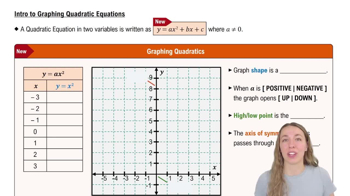
 04:10
04:10