Skip to main content
Beginning & Intermediate Algebra
My Course
Learn
AI Tutor
Study Guides
Flashcards
Explore
Try the app
My Course
Learn
AI Tutor
Study Guides
Flashcards
Explore
Try the app
Back
Geometric Sequences quiz
You can tap to flip the card.
What is the defining characteristic of a geometric sequence?
You can tap to flip the card.
👆
What is the defining characteristic of a geometric sequence?
A geometric sequence is defined by a constant multiplier, called the common ratio, between consecutive terms.
Track progress
Control buttons has been changed to "navigation" mode.
1/15
Related flashcards
Recommended videos
Geometric Sequences definitions
Geometric Sequences
29 Terms
02:11
General Term of a Geometric Sequence Example 1
2
views
06:04
General Term of a Geometric Sequence
1
views
04:50
Intro To Geometric Sequences
2
views
Terms in this set (15)
Hide definitions
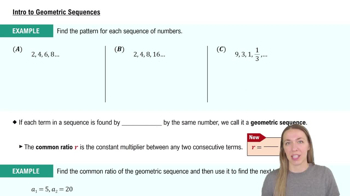
What is the defining characteristic of a geometric sequence?
A geometric sequence is defined by a constant multiplier, called the common ratio, between consecutive terms.
How do you identify the common ratio in a geometric sequence?
You identify the common ratio by dividing any term by its previous term.
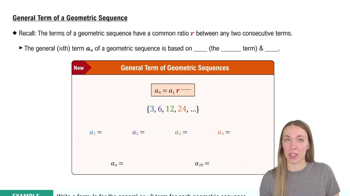
What is the general formula for the nth term of a geometric sequence?
The general formula is an = a1 * r^(n-1), where a1 is the first term and r is the common ratio.
How do you find the next term in a geometric sequence?
Multiply the current term by the common ratio to get the next term.
If the first term is 5 and the second term is 20, what is the common ratio?
The common ratio is 4, since 20 divided by 5 equals 4.
What makes a sequence arithmetic instead of geometric?
An arithmetic sequence has a constant difference between terms, while a geometric sequence has a constant ratio.
How can dividing by a number in a sequence be interpreted in terms of the common ratio?
Dividing by a number is the same as multiplying by its reciprocal, which becomes the common ratio.
What is the common ratio in the sequence 9, 3, 1, 1/3?
The common ratio is 1/3, since each term is multiplied by 1/3 to get the next.
How do you write the second term of a geometric sequence using the first term and the common ratio?
The second term is the first term multiplied by the common ratio: a2 = a1 * r.
In the sequence 3, 6, 12, 24, what is the formula for the nth term?
The nth term is an = 3 * 2^(n-1).
How do you find the value of the 20th term in a geometric sequence with a1 = 3 and r = 2?
Calculate 3 * 2^19 to find the 20th term.
What is the common ratio in the sequence 16/27, 8/9, 3/4, 2?
The common ratio is 3/2, found by dividing 8/9 by 16/27.
How do you express the nth term for the sequence with a1 = 8 and r = 3?
The nth term is an = 8 * 3^(n-1).
What operation do you perform to find the common ratio when terms are fractions?
Divide one term by the previous term, which may involve multiplying by the reciprocal.
Why is the exponent in the general term formula (n-1) instead of n?
Because the first term is multiplied by the common ratio zero times, so the exponent is always one less than the term's position.
 BackBack
 02:11
02:11