Back

Factoring Trinomials of the Form x² + bx + c quiz

Control buttons has been changed to "navigation" mode.
1/15
  • What is the general form of the trinomials we are factoring in this lesson?

    The general form is x² + bx + c.
  • When factoring x² + bx + c, what two properties must the numbers you find satisfy?

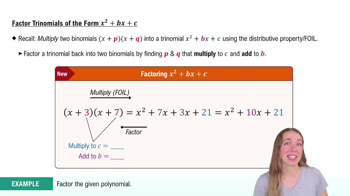
    They must multiply to c and add to b.
  • What mathematical process does factoring x² + bx + c reverse?

    It reverses the FOIL method used to multiply two binomials.
  • In the trinomial x² + 10x + 21, what are the two numbers that multiply to 21 and add to 10?

    The numbers are 3 and 7.
  • How can you check your factoring of a trinomial?

    Multiply the binomials back together to see if you get the original trinomial.
  • What is the factored form of x² + 10x + 21?

    It is (x + 3)(x + 7).
  • What is the first step when factoring x² + 3x - 28?

    Identify the b and c values: b = 3, c = -28.
  • Why is it helpful to use a t-chart when factoring trinomials?

    A t-chart helps organize all possible factor pairs of c.
  • What are the factor pairs of -28 that add to 3?

    The pair is -4 and 7.
  • What is the factored form of x² + 3x - 28?

    It is (x - 4)(x + 7).
  • For x² - 11x + 30, what are the values of b and c?

    b is -11 and c is 30.
  • Which factor pair of 30 adds to -11?

    The pair is -5 and -6.
  • What is the factored form of x² - 11x + 30?

    It is (x - 5)(x - 6).
  • When can you use this factoring technique for trinomials?

    You can use it only when the coefficient of x² is 1.
  • What does the constant term c in x² + bx + c represent when factoring?

    It is the product of the two constants in the binomials.