What is the main challenge when factoring trinomials where the leading coefficient is not 1?
The main challenge is that you must find binomial factors whose first terms multiply to the leading coefficient and whose last terms multiply to the constant term, making the process more complex than when the leading coefficient is 1.
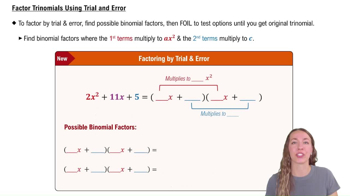
What does the trial and error method for factoring trinomials involve?
It involves making educated guesses for binomial factors and testing them using the FOIL technique until you find the pair that multiplies to the original trinomial.
When using trial and error, what must the first terms of the binomials multiply to?
The first terms must multiply to the leading term, ax², of the trinomial.
What must the last terms of the binomials multiply to in the trial and error method?
The last terms must multiply to the constant term, c, of the trinomial.
How do you check if your guessed binomial factors are correct in the trial and error method?
You use the FOIL technique to expand the binomials and see if the result matches the original trinomial.
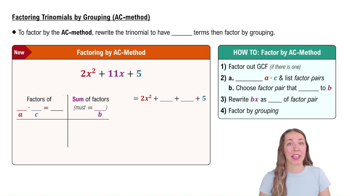
What is the AC method also known as?
The AC method is also referred to as the grouping method.
What is the first step in the AC method for factoring trinomials?
The first step is to multiply the leading coefficient (a) by the constant term (c) to get the product ac.
In the AC method, what do you do after finding the product ac?
You look for two numbers that multiply to ac and add to the middle coefficient, b.
How do you rewrite the trinomial in the AC method after finding the two numbers?
You split the middle term (bx) into two terms using the two numbers found, creating a four-term polynomial.
What factoring technique is applied after rewriting the trinomial into four terms in the AC method?
You use factoring by grouping to factor the four-term polynomial.
Why is it important to pay attention to the signs of the terms when listing factor pairs?
Because the correct combination of positive and negative factors is needed to match both the product and the sum required for the trinomial.
What is the purpose of combining like terms after using the FOIL technique in trial and error?
Combining like terms allows you to check if the expanded binomials match the original trinomial.
How can you verify your factored form is correct for a trinomial?
You can multiply the binomial factors using FOIL to see if you get back the original trinomial.
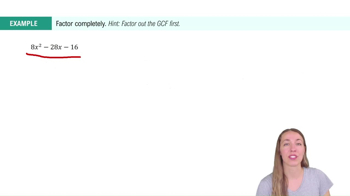
What should you do if the trinomial has a greatest common factor before using the AC method?
You should factor out the greatest common factor first before applying the AC method.
Can the AC method be used for any trinomial of the form ax² + bx + c?
Yes, as long as you can find two numbers that multiply to ac and add to b, the AC method can be used.
 Back
Back

 04:23
04:23