Skip to main content
Beginning & Intermediate Algebra
My Course
Learn
AI Tutor
Study Guides
Flashcards
Explore
Try the app
My Course
Learn
AI Tutor
Study Guides
Flashcards
Explore
Try the app
Back
Direct & Inverse Variation quiz
You can tap to flip the card.
What is the general equation for direct variation?
You can tap to flip the card.
👆
What is the general equation for direct variation?
The general equation for direct variation is y = kx, where k is the constant of variation.
Track progress
Control buttons has been changed to "navigation" mode.
1/15
Related flashcards
Recommended videos
Direct & Inverse Variation definitions
Direct & Inverse Variation
29 Terms
04:31
Direct Variation
1
views
05:33
Inverse Variation
1
views
03:07
Inverse Variation Example 2
1
views
Terms in this set (15)
Hide definitions
What is the general equation for direct variation?
The general equation for direct variation is y = kx, where k is the constant of variation.
How do the variables in a direct variation relationship change with respect to each other?
In direct variation, as one variable increases or decreases, the other does the same.
What does it mean if y is directly proportional to x?
It means y varies directly as x, following the equation y = kx.
How do you find the constant of variation (k) in a direct variation problem?
Substitute the given values of x and y into y = kx and solve for k.
If y = 10 when x = 2 in a direct variation, what is the value of k?
k = 10 / 2 = 5.
Given the direct variation equation y = 5x, what is y when x = 6?
y = 5 × 6 = 30.
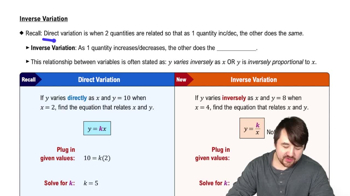
What is the general equation for inverse variation?
The general equation for inverse variation is y = k / x, where k is the constant of variation.
How do the variables in an inverse variation relationship change with respect to each other?
In inverse variation, as one variable increases, the other decreases, and vice versa.
What does it mean if y is inversely proportional to x?
It means y varies inversely as x, following the equation y = k / x.
How do you find the constant of variation (k) in an inverse variation problem?
Substitute the given values of x and y into y = k / x and solve for k.
If y = 8 when x = 4 in an inverse variation, what is the value of k?
k = 8 × 4 = 32.
Given the inverse variation equation y = 32 / x, what is y when x = 2?
y = 32 / 2 = 16.
Why can't x be zero in an inverse variation equation?
Because division by zero is undefined in mathematics.
What is the main difference between direct and inverse variation?
In direct variation, both variables change in the same direction; in inverse variation, they change in opposite directions.
What are some real-world examples where direct or inverse variation might be used?
Examples include price and quantity, distance and time, or time and speed.
 BackBack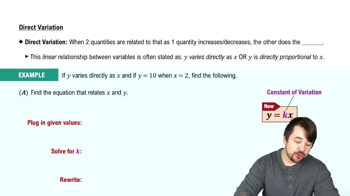
 04:31
04:31