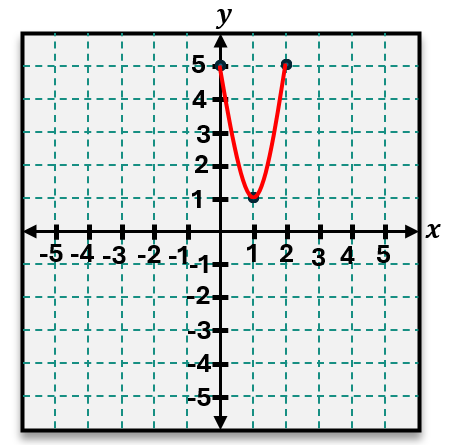
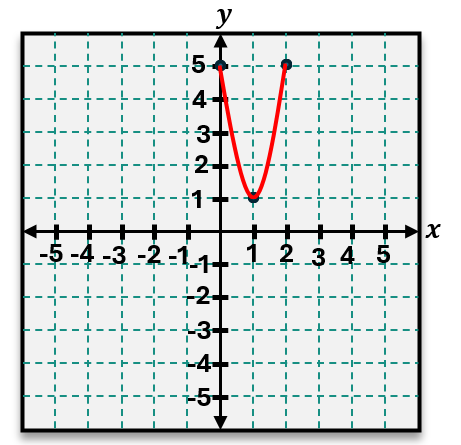
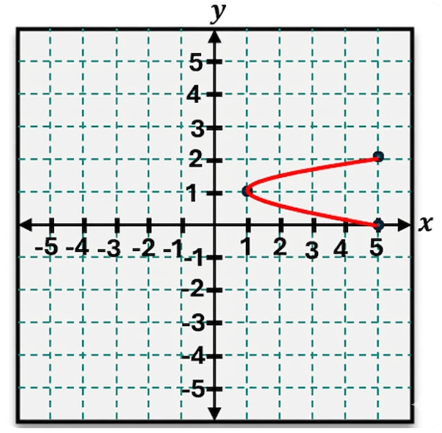
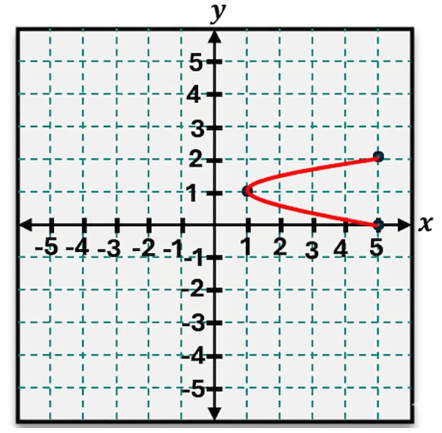
State the vertex, intercepts, and domain & range for each quadratic.
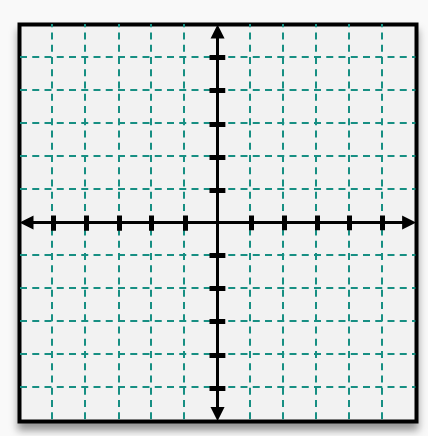
Table of contents
- 1. Review of Real Numbers2h 39m
- 2. Linear Equations and Inequalities3h 38m
- 3. Solving Word Problems2h 43m
- 4. Graphing Linear Equations in Two Variables3h 17m
- 5. Systems of Linear Equations1h 43m
- 6. Exponents and Polynomials3h 25m
- 7. Factoring2h 42m
- 8. Rational Expressions and Equations3h 13m
- 9. Inequalities and Absolute Value2h 52m
- 10. Relations and Functions2h 9m
- 11. Roots, Radicals, and Complex Numbers3h 57m
- 12. Quadratic Equations and Functions3h 5m
- 13. Inverse, Exponential, & Logarithmic Functions2h 30m
- 14. Conic Sections & Systems of Nonlinear Equations2h 24m
- 15. Sequences, Series, and the Binomial Theorem1h 48m
12. Quadratic Equations and Functions
Graphing Quadratic Equations
Multiple Choice
Graph the following quadratics and state its vertex and intercepts.

A
Vertex: , -intercept: ; -intercept: None
B
Vertex: , -intercept: None; -intercept:
C
Vertex: , -intercept: ; -intercept: None
D
Vertex: , -intercept: None; -intercept:
0 Comments
Verified step by step guidance1
Identify the quadratic equation given: \(y = 4x^2 - 8x + 5\).
Find the vertex using the vertex formula \(x = -\frac{b}{2a}\), where \(a = 4\) and \(b = -8\). Calculate \(x\) coordinate of the vertex.
Substitute the \(x\) value of the vertex back into the equation to find the \(y\) coordinate of the vertex.
Find the \(y\)-intercept by evaluating the function at \(x = 0\), which gives the point \((0, y)\).
Find the \(x\)-intercepts by solving the quadratic equation \(4x^2 - 8x + 5 = 0\) using the quadratic formula \(x = \frac{-b \pm \sqrt{b^2 - 4ac}}{2a}\).
Related Videos
Related Practice
Multiple Choice

