Join thousands of students who trust us to help them ace their exams!
Multiple Choice
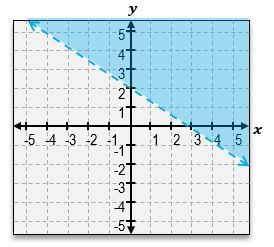
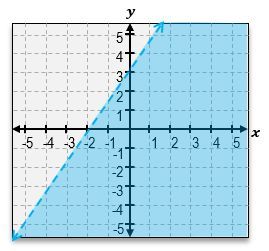
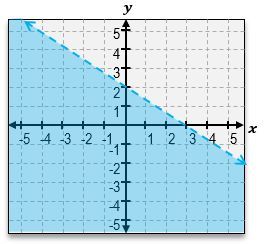
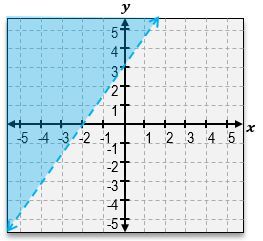
Graph the inequality
A
B
C
D
0 Comments
Verified step by step guidance
1
Start with the inequality: \(2x + 3y < 6\).
Rewrite the inequality as an equation to find the boundary line: \(2x + 3y = 6\).
Solve for \(y\) to get the slope-intercept form: \(3y = 6 - 2x\), so \(y = \frac{6 - 2x}{3} = 2 - \frac{2}{3}x\).
Graph the boundary line \(y = 2 - \frac{2}{3}x\). Since the inequality is '<' (not '≤'), use a dashed line to indicate points on the line are not included.
Determine which side of the line to shade by testing a point not on the line, such as \((0,0)\). Substitute into the inequality: \(2(0) + 3(0) < 6\) which simplifies to \(0 < 6\), a true statement. So, shade the region that includes \((0,0)\).




 Verified step by step guidance