Beginning Algebra
My Course
Learn
AI Tutor
Study Guides
Flashcards
Try the app
My Course
Learn
AI Tutor
Study Guides
Flashcards
Try the app
Back
Graphing Quadratic Equations quiz
You can tap to flip the card.
What is the general standard form of a quadratic equation used for graphing?
You can tap to flip the card.
👆
What is the general standard form of a quadratic equation used for graphing?
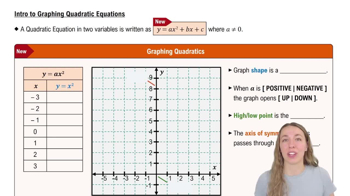
The standard form is y = ax^2 + bx + c, where a ≠ 0.
Track progress
Control buttons has been changed to "navigation" mode.
1/15
Related flashcards
Recommended videos
Graphing Quadratic Equations definitions
Graphing Quadratic Equations
21 Terms
06:28
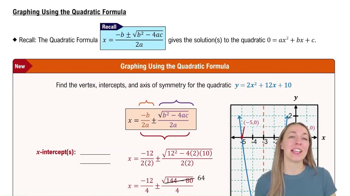
Graphing Using the Quadratic Formula
04:10
Intro to Graphing Quadratic Equations
01:50
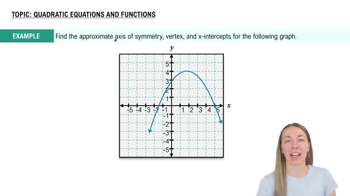
Intro to Graphing Quadratic Equations Example 1
Terms in this set (15)
Hide definitions
What is the general standard form of a quadratic equation used for graphing?
The standard form is y = ax^2 + bx + c, where a ≠ 0.
What is the name of the U-shaped curve formed by the graph of a quadratic equation?
The curve is called a parabola.
How does the sign of the 'a' coefficient affect the direction a parabola opens?
If 'a' is positive, the parabola opens upward; if 'a' is negative, it opens downward.
What is the vertex of a parabola?
The vertex is the highest or lowest point on the parabola, depending on whether it opens up or down.
What is the formula for the axis of symmetry of a parabola in standard form?
The axis of symmetry is given by x = -b/(2a).
How do you find the y-value of the vertex for a quadratic equation?
Substitute the x-value of the vertex into the original equation to find the corresponding y-value.
How do you find the y-intercept of a quadratic equation?
Set x = 0 in the equation and solve for y.
What does the quadratic formula provide when graphing a quadratic equation?
It gives the x-intercepts (roots) of the parabola.
What does the discriminant (b^2 - 4ac) tell you about the graph of a quadratic?
It tells you whether the graph has two, one, or no real x-intercepts.
If the discriminant is positive, how many x-intercepts does the parabola have?
There are two real x-intercepts.
If the discriminant is zero, how many x-intercepts does the parabola have?
There is one real x-intercept.
If the discriminant is negative, how many x-intercepts does the parabola have?
There are no real x-intercepts.
What does the value -b/(2a) represent on the graph of a quadratic equation?
It represents both the axis of symmetry and the x-value of the vertex.
How can you use the quadratic formula to find the distance from the axis of symmetry to each x-intercept?
The distance is given by the value of the square root part of the formula divided by 2a.
What key features should you identify to graph a quadratic equation from standard form?
You should find the vertex, axis of symmetry, x-intercepts, and y-intercept.