Skip to main content
Beginning Algebra
My Course
Learn
Exam Prep
AI Tutor
Study Guides
Flashcards
Try the app
My Course
Learn
Exam Prep
AI Tutor
Study Guides
Flashcards
Try the app
Back
Factoring Trinomials of the Form x² + bx + c definitions
You can tap to flip the card.
Trinomial
You can tap to flip the card.
👆
Trinomial
An algebraic expression with three terms, typically including a squared term, a linear term, and a constant.
Track progress
Control buttons has been changed to "navigation" mode.
1/15
Related flashcards
Related practice
Recommended videos
Factoring Trinomials of the Form x² + bx + c quiz
Factoring Trinomials of the Form x² + bx + c
15 Terms
Factoring Trinomials of the Form x² + bx + c
7. Factoring
5 problems
Topic
ZacharyFrye
Factoring Trinomials of the Form ax² + bx + c
7. Factoring
5 problems
Topic
AllySteele
7. Factoring - Part 1 of 2
4 topics
12 problems
Chapter
JustinRaimundo
7. Factoring - Part 2 of 2
1 topic
3 problems
Chapter
ErnestBlazevic
Guided course
02:03
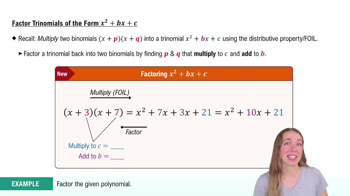
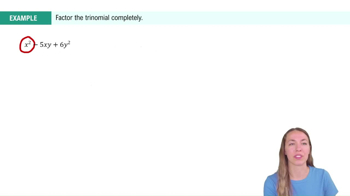
Factoring Trinomials of the Form x² + bx + c Example 1
Guided course
07:23
Factoring Trinomials of the Form x² + bx + c
Terms in this set (15)
Hide definitions
Trinomial
An algebraic expression with three terms, typically including a squared term, a linear term, and a constant.
Binomial
An algebraic expression with two terms, often used as factors when breaking down trinomials.
Coefficient
A numerical factor that multiplies a variable in an algebraic expression, such as the number before x or x².
Constant
A fixed value in an expression that does not contain a variable, often represented as c in trinomials.
Factor Pair
Two numbers whose product equals a given constant and whose sum matches another specified value.
FOIL Method
A technique for multiplying two binomials by combining First, Outside, Inside, and Last terms.
Distributive Property
A rule that allows multiplication to be distributed over addition, essential for expanding or factoring expressions.
Product
The result of multiplying two or more numbers or expressions together, such as the constants in binomials.
Sum
The result of adding two or more numbers, often used to match the middle coefficient in trinomials.
Like Terms
Terms in an expression that have the same variable raised to the same power, which can be combined.
x² Term
The squared variable part of a trinomial, always present with a coefficient of one in this factoring method.
T Chart
A visual tool for organizing factor pairs to systematically find numbers that satisfy both product and sum conditions.
Factored Form
An expression written as a product of simpler expressions, such as two binomials instead of a trinomial.
Middle Term
The linear term in a trinomial, whose coefficient is the sum of the constants from the binomial factors.
Original Trinomial
The starting three-term expression before factoring, typically written as x² plus bx plus c.
 BackBack



 02:03
02:03