Skip to main content
Beginning Algebra
My Course
Learn
AI Tutor
Study Guides
Flashcards
Try the app
My Course
Learn
AI Tutor
Study Guides
Flashcards
Try the app
Back
Direct & Inverse Variation quiz
You can tap to flip the card.
What is the equation for direct variation?
You can tap to flip the card.
👆
What is the equation for direct variation?
The equation for direct variation is y = kx, where k is the constant of variation.
Track progress
Control buttons has been changed to "navigation" mode.
1/15
Related flashcards
Recommended videos
Direct & Inverse Variation definitions
Direct & Inverse Variation
24 Terms
05:33
Inverse Variation
1
views
04:31
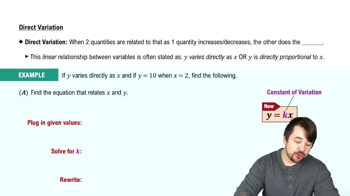
Direct Variation
1
views
04:33
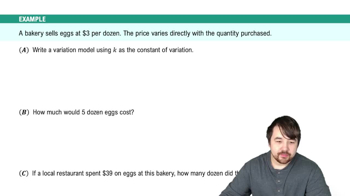
Direct Variation Example 1
1
views
Terms in this set (15)
Hide definitions
What is the equation for direct variation?
The equation for direct variation is y = kx, where k is the constant of variation.
How do y and x change in direct variation?
In direct variation, as one variable increases or decreases, the other does the same.
What does it mean if y is directly proportional to x?
It means y varies directly as x, following the equation y = kx.
How do you find the constant of variation k in direct variation?
Substitute the given values of x and y into y = kx and solve for k.
If y = 10 when x = 2 in a direct variation, what is the equation relating x and y?
The equation is y = 5x, since k = 10/2 = 5.
What is the value of y when x = 6 in the equation y = 5x?
y = 30, because 5 × 6 = 30.
What is the equation for inverse variation?
The equation for inverse variation is y = k/x, where k is the constant of variation.
How do y and x change in inverse variation?
In inverse variation, as one variable increases, the other decreases.
What does it mean if y is inversely proportional to x?
It means y varies inversely as x, following the equation y = k/x.
How do you find the constant of variation k in inverse variation?
Substitute the given values of x and y into y = k/x and solve for k.
If y = 8 when x = 4 in an inverse variation, what is the equation relating x and y?
The equation is y = 32/x, since k = 8 × 4 = 32.
What is the value of y when x = 2 in the equation y = 32/x?
y = 16, because 32 ÷ 2 = 16.
Why can't x be zero in the equation y = k/x?
Because division by zero is undefined in mathematics.
What is a key step in solving both direct and inverse variation problems?
A key step is finding the constant of variation k using given values.
Give an example of real-world quantities that might use direct or inverse variation.
Examples include distance, time, speed, price, quantity, volume, and pressure.
 BackBack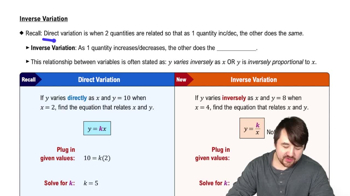
 05:33
05:33