What is the name of the flexible sheet that interconnects the radius and ulna (and the tibia and fibula)?
Ch. 8 The Appendicular Skeleton

Martini, Nath, Bartholomew12th EditionFundamentals of Anatomy and PhysiologyISBN: 9780137854011Not the one you use?Change textbook
Chapter 8, Problem 10
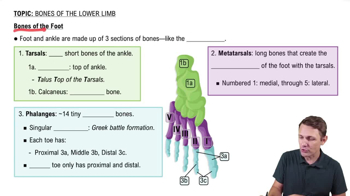
Which seven bones make up the ankle (tarsus)?
Verified step by step guidance1
Step 1: Understand that the ankle, also known as the tarsus, is composed of seven bones that form the connection between the leg and the foot.
Step 2: Identify that these seven bones are collectively called the tarsal bones, which are arranged in two rows: the proximal row and the distal row.
Step 3: List the bones in the proximal row, which includes the talus and the calcaneus. The talus articulates with the tibia and fibula to form the ankle joint, while the calcaneus is the heel bone.
Step 4: List the bones in the distal row, which includes the navicular, the three cuneiform bones (medial, intermediate, and lateral), and the cuboid bone.
Step 5: Summarize that the seven tarsal bones making up the ankle (tarsus) are: talus, calcaneus, navicular, medial cuneiform, intermediate cuneiform, lateral cuneiform, and cuboid.

Verified video answer for a similar problem:
This video solution was recommended by our tutors as helpful for the problem above.
Video duration:
2mWas this helpful?
Key Concepts
Here are the essential concepts you must grasp in order to answer the question correctly.
Ankle (Tarsus) Anatomy
The ankle, or tarsus, is a complex joint composed of seven bones that connect the leg to the foot. Understanding its anatomy is essential for identifying these bones and their roles in movement and support.
Recommended video:
Clitoral Anatomy
Names of the Seven Tarsal Bones
The seven tarsal bones include the talus, calcaneus, navicular, cuboid, and three cuneiform bones (medial, intermediate, and lateral). Each bone has a specific location and function within the ankle structure.
Recommended video:
Guided course
Muscle Naming
Function and Importance of Tarsal Bones
Tarsal bones provide stability, support body weight, and enable foot movements such as walking and running. Recognizing their function helps in understanding injuries and conditions related to the ankle.
Recommended video:
Guided course
Bones of the Foot
Related Practice
Textbook Question
1
views
Textbook Question
The large foramen between the pubic ramus and ischial ramus is the:
(a) Foramen magnum
(b) Suborbital foramen
(c) Acetabulum
(d) Obturator foramen
1
views
Textbook Question
At the glenoid cavity, the scapula articulates with the proximal end of the (a) humerus, (b) radius, (c) ulna, (d) femur.
1
views
Textbook Question
The fibula:
(a) Forms an important part of the knee joint
(b) Articulates with the femur
(c) Helps to bear the weight of the body
(d) Provides lateral stability to the ankle
(e) Does a and b
2
views
Textbook Question
The epiphysis of the femur articulates with the pelvis at the (a) pubic symphysis, (b) acetabulum, (c) sciatic notch, (d) obturator foramen.
Textbook Question
The bones of the hand articulate distally with the:
(a) Carpal bones
(b) Ulna and radius
(c) Metacarpals
(d) Phalanges