Ch. 5 The Integumentary System
Martini - Fundamentals of Anatomy and Physiology 12th Edition
Martini, Nath, Bartholomew12th EditionFundamentals of Anatomy and PhysiologyISBN: 9780137854011Not the one you use?Change textbook
Chapter 5, Problem 21

In clinical practice, drugs can be delivered by diffusion across the skin. This delivery method is called transdermal administration. Why are fat-soluble drugs more suitable for transdermal administration than drugs that are water soluble?

Verified step by step guidance
1
Understand the structure of the skin, focusing on the outermost layer called the stratum corneum, which is composed mainly of dead skin cells embedded in a lipid (fat) matrix.
Recognize that the stratum corneum acts as a barrier to substances trying to penetrate the skin, and its lipid-rich nature makes it more permeable to fat-soluble (lipophilic) substances than to water-soluble (hydrophilic) substances.
Explain that fat-soluble drugs can dissolve in the lipid matrix of the stratum corneum, allowing them to diffuse more easily through this barrier and reach deeper layers of the skin and eventually the bloodstream.
Contrast this with water-soluble drugs, which have difficulty passing through the lipid-rich stratum corneum because they do not dissolve well in lipids, limiting their ability to penetrate the skin effectively.
Conclude that the lipophilicity of fat-soluble drugs enhances their transdermal absorption, making them more suitable for delivery via the skin compared to water-soluble drugs.

Verified video answer for a similar problem:

This video solution was recommended by our tutors as helpful for the problem above.
Video duration:
2m
Was this helpful?

Key Concepts

Here are the essential concepts you must grasp in order to answer the question correctly.

Transdermal Drug Delivery

Transdermal drug delivery involves administering medication through the skin to enter the bloodstream. This method bypasses the digestive system and provides controlled, sustained release of drugs. The skin's outer layer, the stratum corneum, acts as a barrier that drugs must penetrate to be effective.
Recommended video:
1:08
Renal Physiology: Regulation of Glomerular Filtration Example 3

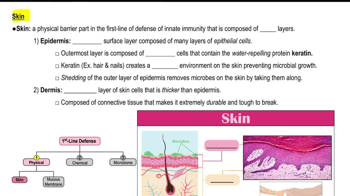
Skin Structure and Barrier Function

The skin's outermost layer, the stratum corneum, is composed mainly of lipids and dead cells, creating a hydrophobic barrier. This lipid-rich environment favors the passage of fat-soluble substances, while water-soluble drugs have difficulty crossing due to their inability to dissolve in lipids.
Recommended video:
4:08
Skin

Solubility and Drug Permeability

Drug solubility affects its ability to penetrate biological membranes. Fat-soluble (lipophilic) drugs dissolve well in the lipid layers of the skin, enhancing absorption. In contrast, water-soluble drugs struggle to cross the lipid barrier, making fat-soluble drugs more suitable for transdermal delivery.
Recommended video:
4:58
Overview of Renal Physiology