Ch. 4 The Tissue Level of Organization
Martini - Fundamentals of Anatomy and Physiology 12th Edition
Martini, Nath, Bartholomew12th EditionFundamentals of Anatomy and PhysiologyISBN: 9780137854011Not the one you use?Change textbook
Chapter 4, Problem 1b

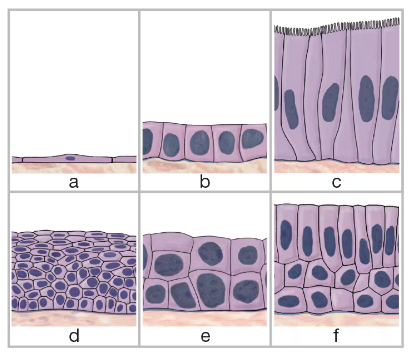
Identify the six types of epithelial tissue shown in the drawing below.
b. ___
Illustration of six types of epithelial tissue cells labeled a to f, showing various shapes and layers.

Verified step by step guidance
1
Step 1: Identify the shape and layering of the cells in each epithelial tissue type. Epithelial tissues are classified based on the number of cell layers (simple = one layer, stratified = multiple layers) and the shape of the cells (squamous = flat, cuboidal = cube-shaped, columnar = tall and column-like).
Step 2: For the first image (top left), observe the single layer of flat cells. This corresponds to 'Simple Squamous Epithelium'.
Step 3: For the second image (top middle), note the single layer of cube-shaped cells. This is 'Simple Cuboidal Epithelium'.
Step 4: For the third image (top right), observe the single layer of tall, column-like cells. This is 'Simple Columnar Epithelium'.
Step 5: For the fourth image (bottom left), see the multiple layers of flat cells on the surface. This is 'Stratified Squamous Epithelium'. For the fifth image (bottom middle), multiple layers of cube-shaped cells indicate 'Stratified Cuboidal Epithelium'. For the sixth image (bottom right), multiple layers with tall cells on the surface indicate 'Stratified Columnar Epithelium'.

Verified video answer for a similar problem:

This video solution was recommended by our tutors as helpful for the problem above.
Video duration:
2m
Was this helpful?

Key Concepts

Here are the essential concepts you must grasp in order to answer the question correctly.

Types of Epithelial Tissue

Epithelial tissues are classified based on cell shape and layering. The six types include simple squamous, simple cuboidal, simple columnar, stratified squamous, stratified cuboidal, and pseudostratified columnar epithelium. Each type has distinct structural features and functions related to protection, absorption, or secretion.
Recommended video:
Guided course
07:25
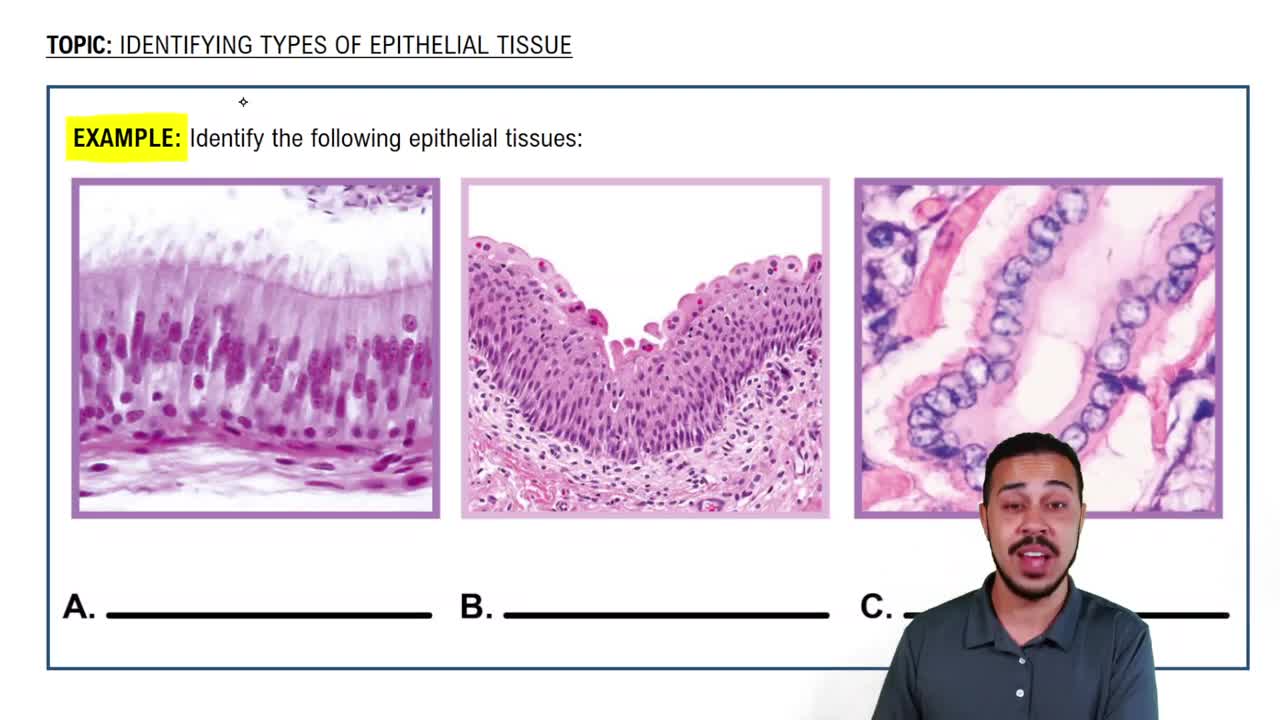
Identifying Types of Epithelial Tissue Example 1

Cell Shape and Layering in Epithelium

Epithelial cells are categorized by shape: squamous (flat), cuboidal (cube-shaped), and columnar (tall and column-like). Layering can be simple (one layer), stratified (multiple layers), or pseudostratified (appears layered but all cells contact the basement membrane). These characteristics determine tissue function and location.
Recommended video:
04:52
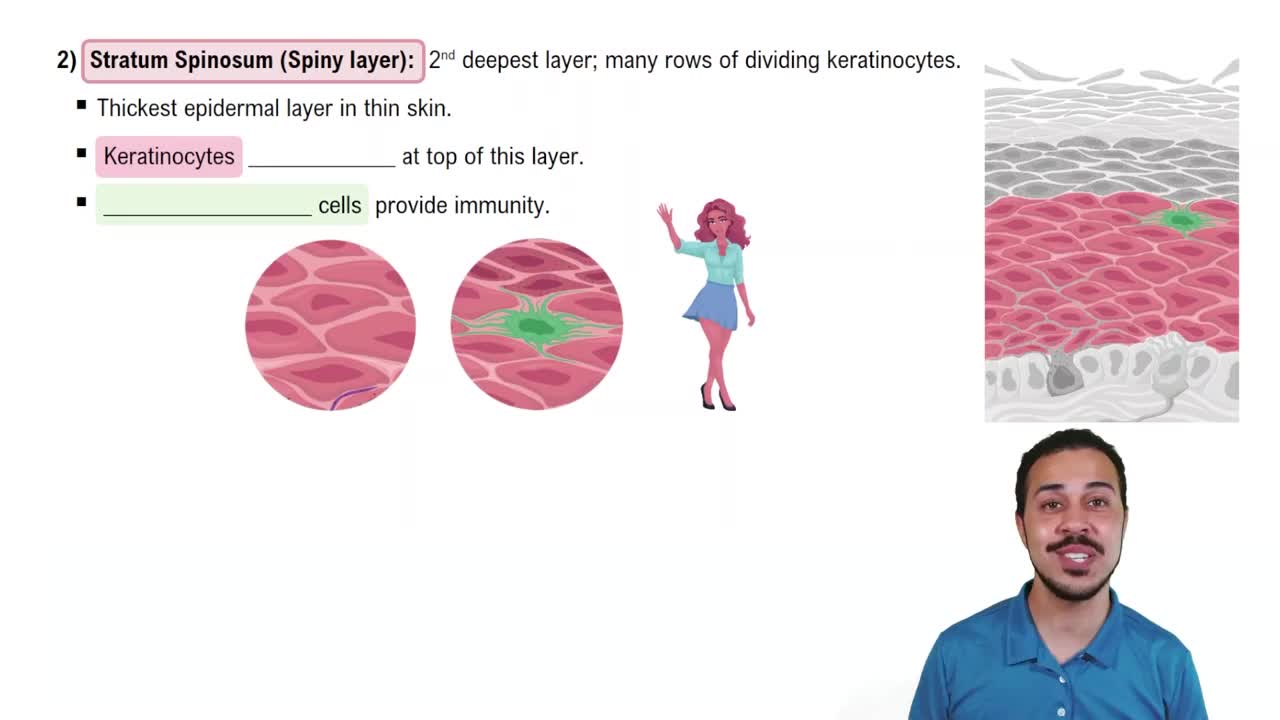
Epidermal Layers: Stratum Spinosum (Spiny Layer)

Functional Adaptations of Epithelial Tissue

Different epithelial types serve specific roles: simple epithelia facilitate diffusion and absorption, stratified epithelia provide protection against abrasion, and pseudostratified epithelium often includes cilia for moving substances. Understanding these adaptations helps identify tissue types and their physiological roles.
Recommended video:
Guided course
07:25
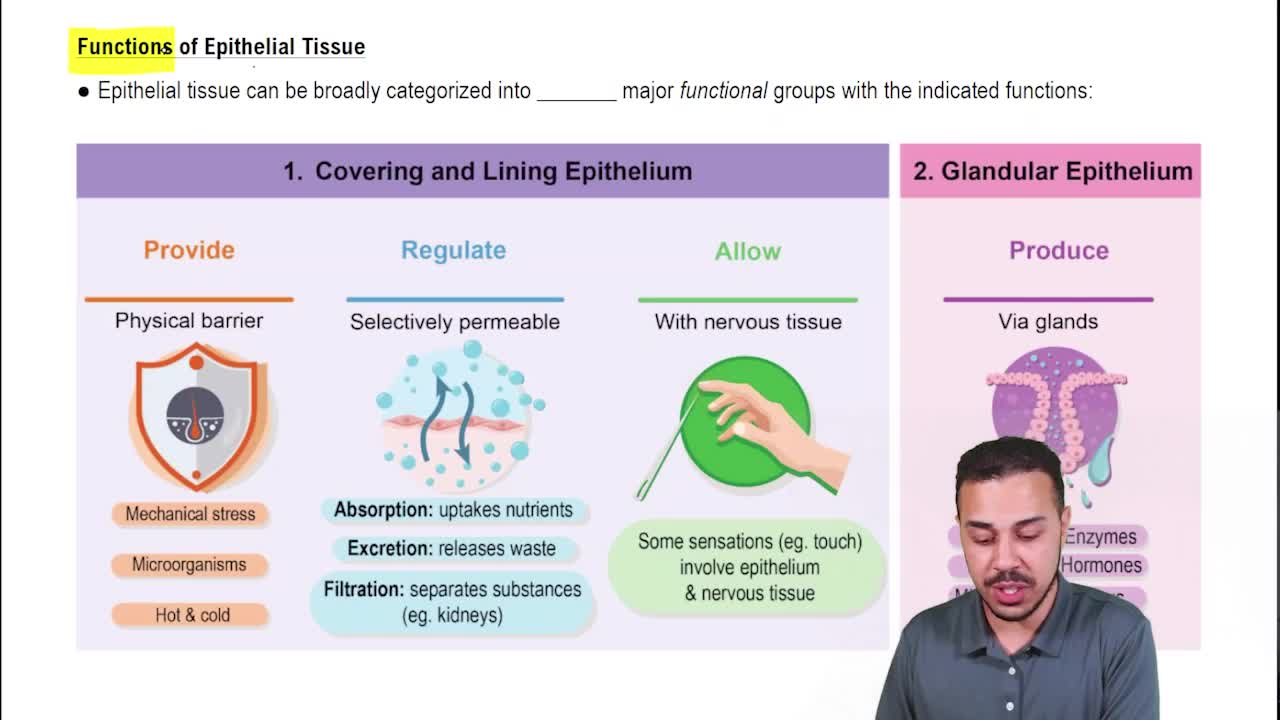
Functions of Epithelial Tissue