Ch. 27 Fluids & Electrolytes
Martini - Fundamentals of Anatomy and Physiology 12th Edition
Martini, Nath, Bartholomew12th EditionFundamentals of Anatomy and PhysiologyISBN: 9780137854011Not the one you use?Change textbook
Chapter 26, Problem 11

Drinking a solution hypotonic to the ECF causes the ECF to:
(a) Increase in volume and become hypertonic to the ICF
(b) Decrease in volume and become hypertonic to the ICF
(c) Decrease in volume and become hypotonic to the ICF
(d) Increase in volume and become hypotonic to the ICF

Verified step by step guidance
1
Step 1: Understand the terms involved. The ECF (extracellular fluid) is the fluid outside cells, and the ICF (intracellular fluid) is the fluid inside cells. 'Hypotonic' means having a lower solute concentration compared to another solution, while 'hypertonic' means having a higher solute concentration.
Step 2: Recognize that drinking a hypotonic solution means introducing fluid with lower solute concentration than the ECF into the body, which will dilute the ECF, lowering its solute concentration.
Step 3: Since the ECF solute concentration decreases, water will move by osmosis from the ECF into the ICF (cells) because water moves from areas of lower solute concentration to higher solute concentration to balance osmotic pressure.
Step 4: As water moves into the cells, the volume of the ECF decreases because fluid is leaving the extracellular space and entering the intracellular space.
Step 5: Because the ECF solute concentration is now lower than that of the ICF, the ECF becomes hypotonic relative to the ICF.

Verified video answer for a similar problem:

This video solution was recommended by our tutors as helpful for the problem above.
Was this helpful?

Key Concepts

Here are the essential concepts you must grasp in order to answer the question correctly.

Extracellular Fluid (ECF) and Intracellular Fluid (ICF) Compartments

The body’s fluids are divided mainly into ECF (outside cells) and ICF (inside cells). Understanding their volumes and solute concentrations is essential because fluid shifts between these compartments depend on osmotic gradients created by solute differences.
Recommended video:
Guided course
2:39
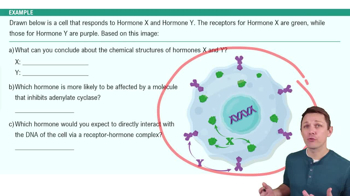
Intracellular Receptors and Direct Gene Action Example 1

Tonicity and Its Effect on Cell Volume

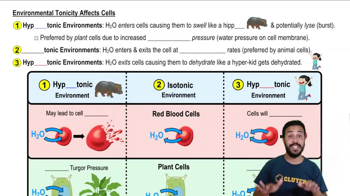
Tonicity refers to the relative concentration of solutes in a solution compared to another solution, affecting water movement. A hypotonic solution has lower solute concentration, causing water to move into cells, potentially increasing cell volume and altering ECF volume and tonicity.
Recommended video:
10:15
Environmental Tonicity Affects Cells

Osmosis and Fluid Movement Across Cell Membranes

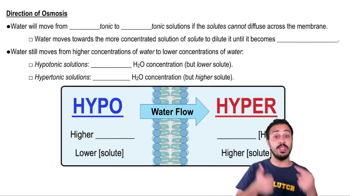
Osmosis is the passive movement of water across a semipermeable membrane from a region of lower solute concentration to higher solute concentration. When hypotonic fluid is ingested, water moves from ECF into ICF, changing volumes and solute concentrations in both compartments.
Recommended video:
06:48
Direction of Osmosis
Related Practice