Ch. 26 The Urinary System
Martini - Fundamentals of Anatomy and Physiology 12th Edition
Martini, Nath, Bartholomew12th EditionFundamentals of Anatomy and PhysiologyISBN: 9780137854011Not the one you use?Change textbook
Chapter 25, Problem 10

Name the segments of the nephron distal to the renal corpuscle, and state the functions of each.

Verified step by step guidance
1
Identify the segments of the nephron that are located distal (further along) to the renal corpuscle. These include the proximal convoluted tubule, the loop of Henle (descending and ascending limbs), the distal convoluted tubule, and the collecting duct.
Describe the function of the proximal convoluted tubule: it reabsorbs the majority of filtered substances such as water, ions (like sodium and chloride), glucose, and amino acids back into the bloodstream.
Explain the role of the loop of Henle: the descending limb primarily allows water to be reabsorbed into the surrounding medulla, concentrating the filtrate, while the ascending limb actively transports ions out but is impermeable to water, diluting the filtrate.
Outline the function of the distal convoluted tubule: it fine-tunes ion reabsorption and secretion, particularly sodium, potassium, and calcium, under hormonal control (e.g., aldosterone and parathyroid hormone), contributing to electrolyte and pH balance.
Describe the collecting duct's role: it collects filtrate from multiple nephrons and adjusts water reabsorption under the influence of antidiuretic hormone (ADH), thus regulating urine concentration and volume before the filtrate exits as urine.

Verified video answer for a similar problem:

This video solution was recommended by our tutors as helpful for the problem above.
Was this helpful?

Key Concepts

Here are the essential concepts you must grasp in order to answer the question correctly.

Segments of the Nephron Distal to the Renal Corpuscle

The nephron segments distal to the renal corpuscle include the proximal convoluted tubule, loop of Henle, distal convoluted tubule, and collecting duct. Each segment has distinct structural and functional roles in processing the filtrate formed in the renal corpuscle.
Recommended video:
4:52
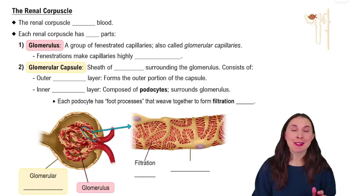
The Renal Corpuscle

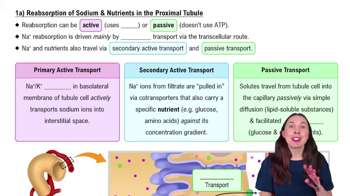
Functions of the Proximal Convoluted Tubule and Loop of Henle

The proximal convoluted tubule reabsorbs most of the filtered water, ions, and nutrients like glucose. The loop of Henle creates a concentration gradient in the medulla, enabling water reabsorption and urine concentration through its descending and ascending limbs.
Recommended video:
6:51
1a) Reabsorption of Sodium & Nutrients in the Proximal Tubule

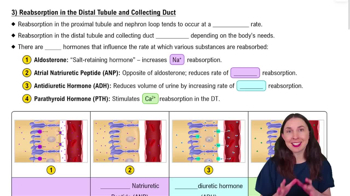
Functions of the Distal Convoluted Tubule and Collecting Duct

The distal convoluted tubule fine-tunes ion reabsorption and secretion, influenced by hormones like aldosterone. The collecting duct regulates water reabsorption under antidiuretic hormone control, concentrating urine and maintaining body fluid balance.
Recommended video:
4:24
3) Reabsorption in the Distal Tubule and Collecting Duct