Textbook Question
Perforins are proteins associated with the activity of
(a) T cells
(b) B cells
(c) NK cells
(d) Plasma cells
1
views

 Martini, Nath, Bartholomew 12th EditionCh. 22 The Lymphatic System and ImmunityProblem 6
 Verified step by step guidance
 7:11
7:11
 7:49
7:49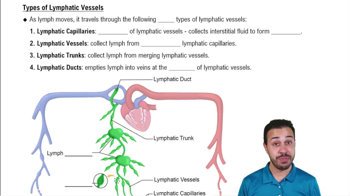 7:02
7:02Perforins are proteins associated with the activity of
(a) T cells
(b) B cells
(c) NK cells
(d) Plasma cells
Phagocytes move through capillary walls by squeezing between adjacent endothelial cells, a process known as
(a) Diapedesis
(b) Chemotaxis
(c) Adhesion
(d) Perforation
The major histocompatibility complex (MHC)
(a) Is responsible for forming lymphocytes
(b) Produces antibodies in lymph glands
(c) Is a group of genes that codes for human leukocyte antigens
(d) Is a membrane protein that can recognize foreign antigens
(e) Is the antigen found on bacteria that stimulates an immune response
The specificity of an antibody is determined by the
(a) Fixed segment
(b) Antigenic determinants
(c) Variable region
(d) Size of the antibody
(e) Antibody class
Complement activation
(a) Stimulates inflammation
(b) Attracts phagocytes
(c) Enhances phagocytosis
(d) Achieves a, b, and c
Anatomically, lymphatic vessels resemble
(a) Elastic arteries
(b) Muscular arteries
(c) Arterioles
(d) Medium veins
(e) The venae cavae