Ch. 21 Blood Vessels and Circulation
Martini - Fundamentals of Anatomy and Physiology 12th Edition
Martini, Nath, Bartholomew12th EditionFundamentals of Anatomy and PhysiologyISBN: 9780137854011Not the one you use?Change textbook
Chapter 21, Problem 2

The blood vessels that play the most important role in regulating blood pressure and blood flow to a tissue are the:
(a) Arteries
(b) Arterioles
(c) Veins
(d) Venules
(e) Capillaries

Verified step by step guidance
1
Step 1: Understand the function of each type of blood vessel listed in the problem. Arteries carry blood away from the heart and have thick walls to handle high pressure.
Step 2: Recognize that arterioles are smaller branches of arteries that lead to capillaries and have muscular walls capable of constricting or dilating.
Step 3: Recall that veins carry blood back to the heart and have thinner walls with valves to prevent backflow, but they are less involved in regulating blood pressure.
Step 4: Note that venules are small vessels that collect blood from capillaries and lead into veins, playing a minor role in pressure regulation.
Step 5: Understand that capillaries are tiny vessels where exchange of gases and nutrients occurs, but they do not regulate blood pressure or flow significantly.

Verified video answer for a similar problem:

This video solution was recommended by our tutors as helpful for the problem above.
Was this helpful?

Key Concepts

Here are the essential concepts you must grasp in order to answer the question correctly.

Arterioles and Their Role in Blood Flow Regulation

Arterioles are small blood vessels that branch from arteries and lead to capillaries. They have muscular walls that can constrict or dilate, allowing them to regulate blood flow and pressure by changing their diameter. This ability makes them the primary site for controlling blood distribution to tissues.
Recommended video:
6:40
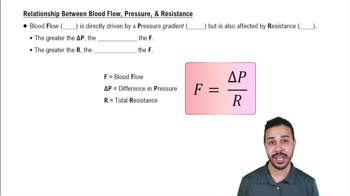
Relationship Between Blood Flow, Pressure, & Resistance

Blood Pressure Regulation

Blood pressure is the force exerted by circulating blood on vessel walls. It is mainly influenced by the resistance in blood vessels, especially arterioles, which adjust their diameter to increase or decrease resistance, thereby controlling systemic blood pressure and ensuring adequate tissue perfusion.
Recommended video:
Guided course
6:12
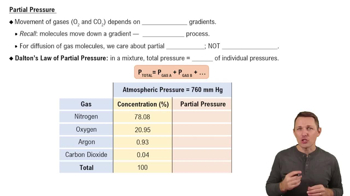
Partial Pressure

Differences Between Blood Vessel Types

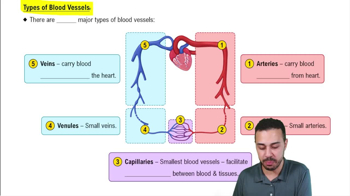
Arteries, veins, arterioles, venules, and capillaries differ in structure and function. Arteries carry blood away from the heart under high pressure, veins return blood to the heart, capillaries facilitate exchange of gases and nutrients, while arterioles and venules regulate flow and pressure at the microcirculatory level.
Recommended video:
5:34
Types of Blood Vessels