What are the valves in the heart, and what is the function of each?
Ch. 20 The Heart

Martini, Nath, Bartholomew12th EditionFundamentals of Anatomy and PhysiologyISBN: 9780137854011Not the one you use?Change textbook
Chapter 20, Problem 16
What is the cardiac cycle? What phases and events are necessary to complete a cardiac cycle?
Verified step by step guidance1
Begin by defining the cardiac cycle as the sequence of mechanical and electrical events that repeat with every heartbeat, involving the contraction and relaxation of the atria and ventricles to pump blood effectively.
Identify the two main phases of the cardiac cycle: diastole (when the heart muscle relaxes and chambers fill with blood) and systole (when the heart muscle contracts and pumps blood out).
Explain the atrial systole phase, where the atria contract to push blood into the ventricles, completing ventricular filling.
Describe the ventricular systole phase, where the ventricles contract, causing the atrioventricular (AV) valves to close and the semilunar valves to open, allowing blood to be ejected into the arteries.
Conclude with ventricular diastole, where the ventricles relax, semilunar valves close to prevent backflow, and the AV valves open to allow the ventricles to fill again, completing the cycle.

Verified video answer for a similar problem:
This video solution was recommended by our tutors as helpful for the problem above.
Was this helpful?
Key Concepts
Here are the essential concepts you must grasp in order to answer the question correctly.
Cardiac Cycle
The cardiac cycle refers to the sequence of mechanical and electrical events that repeat with every heartbeat, involving the contraction and relaxation of the atria and ventricles to pump blood effectively through the heart and circulatory system.
Recommended video:
Guided course
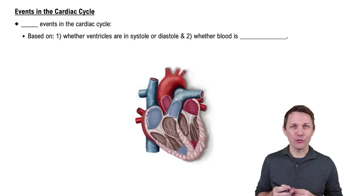
Events in the Cardiac Cycle
Phases of the Cardiac Cycle
The cardiac cycle consists of two main phases: systole, when the heart muscles contract to pump blood out, and diastole, when the heart muscles relax to allow chambers to fill with blood. These phases ensure continuous blood flow.
Recommended video:
Guided course
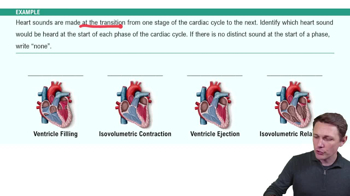
Cardiac Cycle Example 3
Key Events in the Cardiac Cycle
Essential events include atrial contraction, ventricular contraction, opening and closing of heart valves (atrioventricular and semilunar valves), and blood flow through the heart chambers, all coordinated to maintain efficient circulation.
Recommended video:
Guided course
Events in the Cardiac Cycle
Related Practice
Textbook Question
7
views
Textbook Question
Trace the normal pathway of an electrical impulse through the conducting system of the heart.
1
views
Textbook Question
Describe the three distinct layers that make up the heart wall.
1
views
Textbook Question
What three factors regulate stroke volume to ensure that the left and right ventricles pump equal volumes of blood?
1
views
Textbook Question
The cells of the conducting system differ from the contractile cells of the heart in that:
(a) Conducting cells are larger and contain more myofibrils
(b) Contractile cells exhibit pacemaker potentials
(c) Contractile cells do not normally exhibit autorhythmicity
(d) Both a and b are correct
1
views
Textbook Question
Which of the following is longer?
(a) The refractory period of a cardiac contractile cell.
(b) The refractory period of skeletal muscle fiber.
1
views