Ch. 20 The Heart
Martini - Fundamentals of Anatomy and Physiology 12th Edition
Martini, Nath, Bartholomew12th EditionFundamentals of Anatomy and PhysiologyISBN: 9780137854011Not the one you use?Change textbook
Chapter 20, Problem 2

The autonomic centers for cardiac function are located in:
(a) The myocardial tissue of the heart
(b) The cardiac centers of the medulla oblongata
(c) The cerebral cortex
(d) All of these structures

Verified step by step guidance
1
Step 1: Understand the role of autonomic centers in cardiac function. These centers regulate heart rate and force of contraction through the autonomic nervous system, which includes sympathetic and parasympathetic pathways.
Step 2: Identify the location of the primary autonomic centers controlling the heart. The medulla oblongata, part of the brainstem, contains the cardiac centers responsible for autonomic regulation of heart activity.
Step 3: Recognize that myocardial tissue itself is the effector tissue that responds to autonomic signals but does not contain autonomic centers.
Step 4: Note that the cerebral cortex is involved in higher brain functions and voluntary control, but it does not house autonomic centers for cardiac function.
Step 5: Conclude that the autonomic centers for cardiac function are located specifically in the cardiac centers of the medulla oblongata, making option (b) the correct choice.

Verified video answer for a similar problem:

This video solution was recommended by our tutors as helpful for the problem above.
Was this helpful?

Key Concepts

Here are the essential concepts you must grasp in order to answer the question correctly.

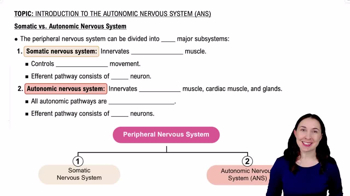
Autonomic Nervous System and Cardiac Regulation

The autonomic nervous system (ANS) controls involuntary functions, including heart rate and force of contraction. It has two branches: sympathetic, which increases cardiac activity, and parasympathetic, which decreases it. Understanding how the ANS regulates the heart is essential to locate the autonomic centers.
Recommended video:
1:50
Somatic vs. Autonomic Nervous System

Cardiac Centers in the Medulla Oblongata

The medulla oblongata contains specific autonomic centers that regulate heart function by sending signals through the ANS. These cardiac centers adjust heart rate and strength of contraction in response to body needs, making them the primary autonomic control sites for cardiac function.
Recommended video:
Guided course
9:44
Events in the Cardiac Cycle

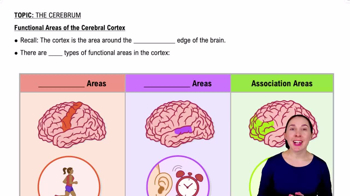
Role of Myocardial Tissue and Cerebral Cortex in Cardiac Function

Myocardial tissue is the heart muscle responsible for contraction but does not control autonomic regulation. The cerebral cortex influences voluntary and emotional responses but does not directly regulate cardiac autonomic centers. Distinguishing these roles clarifies the location of autonomic cardiac centers.
Recommended video:
4:49
Functional Areas of the Cerebral Cortex