Ch. 20 The Heart
Martini - Fundamentals of Anatomy and Physiology 12th Edition
Martini, Nath, Bartholomew12th EditionFundamentals of Anatomy and PhysiologyISBN: 9780137854011Not the one you use?Change textbook
Chapter 20, Problem 29

Harvey has a heart murmur in his left ventricle that produces a loud 'gurgling' sound at the beginning of systole. Which valve is probably faulty?

Verified step by step guidance
1
Understand the phases of the cardiac cycle: systole is the phase when the ventricles contract to pump blood out of the heart.
Identify which valves are involved in the left ventricle during systole: the aortic valve opens to allow blood to flow into the aorta, and the mitral valve closes to prevent backflow into the left atrium.
Recognize that a murmur occurring at the beginning of systole suggests a problem with a valve that should be closing or opening at that time.
Since the murmur is described as a 'gurgling' sound in the left ventricle at the start of systole, consider that the mitral valve might be faulty, possibly leaking (mitral regurgitation) as it should be closed during ventricular contraction.
Conclude that the faulty valve is likely the mitral valve, as it is the valve between the left atrium and left ventricle responsible for preventing backflow during systole.

Verified video answer for a similar problem:

This video solution was recommended by our tutors as helpful for the problem above.
Was this helpful?

Key Concepts

Here are the essential concepts you must grasp in order to answer the question correctly.

Heart Valves and Their Locations

The heart has four main valves: mitral and tricuspid (atrioventricular valves) and aortic and pulmonary (semilunar valves). The mitral valve is located between the left atrium and left ventricle, controlling blood flow into the left ventricle during diastole.
Recommended video:
Guided course
3:55
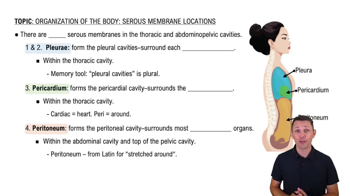
Locations of Serous Membranes

Systole and Valve Function

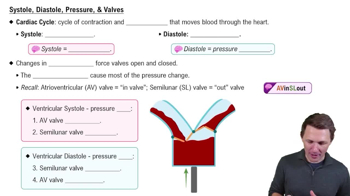
Systole is the phase of the cardiac cycle when the ventricles contract to pump blood out. During systole, the atrioventricular valves (mitral and tricuspid) should be closed to prevent backflow, while the semilunar valves open to allow blood ejection.
Recommended video:
Guided course
7:13
Systole, Diastole, Pressure, & Valves

Heart Murmurs and Valve Dysfunction

Heart murmurs are abnormal sounds caused by turbulent blood flow, often due to valve defects. A loud 'gurgling' sound at the start of systole in the left ventricle suggests mitral valve regurgitation, where the valve leaks and allows blood to flow backward into the left atrium.
Recommended video:
Guided course
7:13
Systole, Diastole, Pressure, & Valves