Ch. 2 The Chemical Level of Organization
Martini - Fundamentals of Anatomy and Physiology 12th Edition
Martini, Nath, Bartholomew12th EditionFundamentals of Anatomy and PhysiologyISBN: 9780137854011Not the one you use?Change textbook
Chapter 2, Problem 24

Explain how enzymes function in chemical reactions.

Verified step by step guidance
1
Understand that enzymes are biological catalysts that speed up chemical reactions without being consumed in the process.
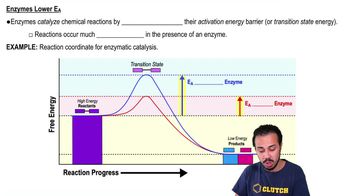
Recognize that enzymes work by lowering the activation energy required for a reaction to proceed, making it easier for reactants to convert into products.
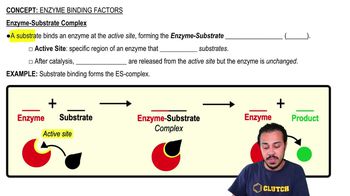
Identify the active site of the enzyme, which is a specific region where substrate molecules bind, forming an enzyme-substrate complex.
Explain that the enzyme stabilizes the transition state and properly orients the substrates, facilitating the conversion to products.
Note that after the reaction, the products are released from the enzyme, which remains unchanged and ready to catalyze another reaction.

Verified video answer for a similar problem:

This video solution was recommended by our tutors as helpful for the problem above.
Video duration:
2m
Was this helpful?

Key Concepts

Here are the essential concepts you must grasp in order to answer the question correctly.

Enzyme Structure and Active Site

Enzymes are proteins with a specific three-dimensional structure that includes an active site. The active site is where substrates bind, allowing the enzyme to catalyze a chemical reaction by stabilizing the transition state and lowering activation energy.
Recommended video:
04:18
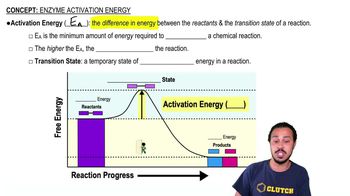
Enzyme Activation Energy

Catalysis and Activation Energy

Enzymes speed up chemical reactions by lowering the activation energy required for the reaction to proceed. This makes reactions occur faster without being consumed in the process, enabling biological processes to happen efficiently at normal temperatures.
Recommended video:
03:26
Enzymes Lower Activation Energy

Substrate Specificity and Enzyme-Substrate Complex

Enzymes are highly specific to their substrates, binding only certain molecules to form an enzyme-substrate complex. This specificity ensures that enzymes catalyze only particular reactions, which is crucial for regulating metabolic pathways.
Recommended video:
03:49
Enzyme-Substrate Complex