Relate the structure of hemoglobin to its function.
Ch. 19 Blood

Martini, Nath, Bartholomew12th EditionFundamentals of Anatomy and PhysiologyISBN: 9780137854011Not the one you use?Change textbook
Chapter 19, Problem 24
How do elements of blood defend against toxins and pathogens in the body?
Verified step by step guidance1
Identify the key elements of blood involved in defense: primarily white blood cells (leukocytes), antibodies, and complement proteins.
Explain the role of white blood cells, such as neutrophils and macrophages, which engulf and destroy pathogens through a process called phagocytosis.
Describe how lymphocytes, including B cells and T cells, contribute by recognizing specific antigens on pathogens and either producing antibodies or directly killing infected cells.
Discuss the function of antibodies produced by B cells, which bind to toxins and pathogens to neutralize them or mark them for destruction by other immune cells.
Mention the complement system, a group of proteins in the blood that enhances the ability of antibodies and phagocytic cells to clear microbes and damaged cells, promoting inflammation and attacking the pathogen's membrane.

Verified video answer for a similar problem:
This video solution was recommended by our tutors as helpful for the problem above.
Was this helpful?
Key Concepts
Here are the essential concepts you must grasp in order to answer the question correctly.
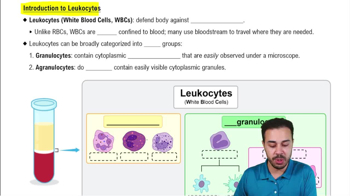
White Blood Cells (Leukocytes)
White blood cells are crucial components of the immune system that identify, attack, and destroy pathogens like bacteria and viruses. Different types, such as neutrophils and lymphocytes, perform specialized roles including engulfing invaders and producing antibodies.
Recommended video:
Introduction to Leukocytes
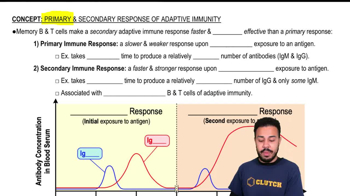
Antibodies and the Immune Response
Antibodies are proteins produced by certain white blood cells that specifically recognize and bind to toxins or pathogens, neutralizing them or marking them for destruction. This targeted response helps the body efficiently eliminate harmful substances.
Recommended video:
Primary and Secondary Response of Adaptive Immunity
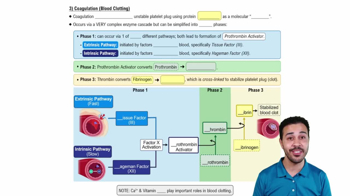
Platelets and Blood Clotting
Platelets help prevent the spread of toxins and pathogens by forming clots at injury sites, sealing wounds to block entry points for microbes. This physical barrier supports the immune defense by limiting infection and promoting healing.
Recommended video:
Coagulation (Blood Clotting)
Related Practice
Textbook Question
3
views
Textbook Question
What is the role of blood in the stabilization and maintenance of body temperature?
Textbook Question
A difference between the A, B, and O blood types and the Rh factor is:
(a) Rh agglutinogens are not found on the surface of red blood cells
(b) Rh agglutinogens do not produce a cross-reaction
(c) Individuals who are Rh− do not carry agglutinins to Rh factor unless they have been previously sensitized
(d) Rh agglutinogens are found free in the plasma
(e) Rh agglutinogens are found bound to plasma proteins
Textbook Question
How do red blood cells differ from white blood cells in both form and function?
Textbook Question
Why is aspirin sometimes prescribed for the prevention of vascular problems?
2
views
Textbook Question
The waste product bilirubin is formed from:
(a) Transferrin
(b) Globin
(c) Heme
(d) Hemosiderin
(e) Ferritin
1
views