Juan tells his physician that he has been feeling dizzy, especially when he closes his eyes. He is asked to stand with his feet together and arms extended forward. As long as he keeps his eyes open, he exhibits very little movement. But when he closes his eyes, his body begins to sway a great deal, and his arms tend to drift together toward the left side of his body. Why does this occur?

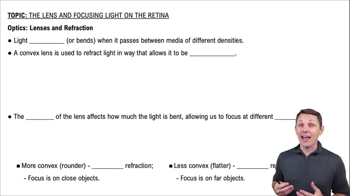
Your friend Shelly suffers from myopia (nearsightedness). You remember from your physics class that concave lenses cause light waves to spread or diverge and that convex lenses cause light waves to converge. What type of corrective lenses would you suggest to your friend?
(a) Concave lenses
(b) Convex lenses
Verified step by step guidance
Verified video answer for a similar problem:
Key Concepts
Myopia (Nearsightedness)
Concave Lenses and Light Divergence
Convex Lenses and Light Convergence
You are at a park watching some deer 35 feet away from you. A friend taps you on the shoulder to ask a question. As you turn to look at your friend, who is standing just 2 feet away, what changes would your eyes undergo?
Damage to the ampullary cupula of the lateral semicircular duct would interfere with the perception of
(a) The direction of gravitational pull
(b) Linear acceleration
(c) Horizontal rotation of the head
(d) Vertical rotation of the head
(e) Angular rotation of the head
Displacement of stereocilia toward the kinocilium of a hair cell
(a) Produces a depolarization of the membrane
(b) Produces a hyperpolarization of the membrane
(c) Decreases the membrane permeability to sodium ions
(d) Increases the membrane permeability to potassium ions
(e) Does not affect the membrane potential of the cell
