Ch. 16 The Autonomic Nervous System and Higher-Order Functions
Martini - Fundamentals of Anatomy and Physiology 12th Edition
Martini, Nath, Bartholomew12th EditionFundamentals of Anatomy and PhysiologyISBN: 9780137854011Not the one you use?Change textbook
Chapter 16, Problem 12

All preganglionic autonomic fibers release______at their axon terminals, and the effects are always_____ .
(a) norepinephrine, inhibitory
(b) norepinephrine, excitatory
(c) acetylcholine, excitatory
(d) acetylcholine, inhibitory

Verified step by step guidance
1
Understand that the autonomic nervous system consists of preganglionic and postganglionic fibers, which release specific neurotransmitters to communicate with their target cells.
Recall that all preganglionic autonomic fibers, regardless of whether they belong to the sympathetic or parasympathetic division, release the same neurotransmitter at their axon terminals.
Identify the neurotransmitter released by preganglionic fibers, which is acetylcholine (ACh). This is a key fact in autonomic physiology.
Recognize that the effect of acetylcholine released by preganglionic fibers on the postganglionic neurons is always excitatory, meaning it stimulates the next neuron to fire.
Conclude that the correct answer must state that preganglionic autonomic fibers release acetylcholine and that the effect is excitatory.

Verified video answer for a similar problem:

This video solution was recommended by our tutors as helpful for the problem above.
Was this helpful?

Key Concepts

Here are the essential concepts you must grasp in order to answer the question correctly.

Preganglionic Autonomic Fibers

Preganglionic autonomic fibers are nerve fibers that originate in the central nervous system and extend to autonomic ganglia. They transmit signals to postganglionic neurons, initiating autonomic responses. Understanding their neurotransmitter release is key to grasping autonomic nervous system function.
Recommended video:
1:50
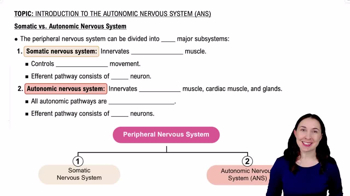
Somatic vs. Autonomic Nervous System

Neurotransmitters in the Autonomic Nervous System

Neurotransmitters are chemical messengers released at nerve terminals to communicate with target cells. In the autonomic nervous system, acetylcholine and norepinephrine are primary neurotransmitters, with acetylcholine typically released by preganglionic fibers and norepinephrine by most postganglionic fibers.
Recommended video:
1:50
Somatic vs. Autonomic Nervous System

Excitatory vs. Inhibitory Effects

Neurotransmitters can have excitatory effects, promoting action potentials in the target cell, or inhibitory effects, reducing the likelihood of activation. The effect depends on the receptor type and location, influencing how autonomic signals regulate organ function.
Recommended video:
1:32
Effects of the Complement System