Ch. 15 Sensory Pathways and the Somatic Nervous System
Martini - Fundamentals of Anatomy and Physiology 12th Edition
Martini, Nath, Bartholomew12th EditionFundamentals of Anatomy and PhysiologyISBN: 9780137854011Not the one you use?Change textbook
Chapter 15, Problem 5

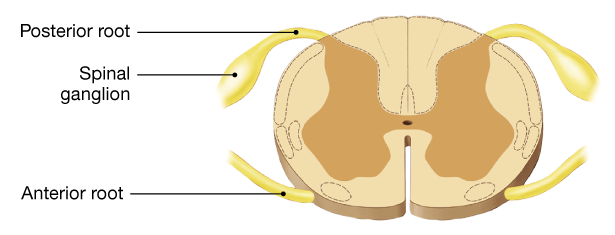
Identify and shade in the locations of all the ascending sensory tracts in the following diagram of the spinal cord.
Cross-sectional diagram of the spinal cord showing labeled posterior root, spinal ganglion, and anterior root nerves.

Verified step by step guidance
1
Step 1: Understand that ascending sensory tracts carry sensory information from the body to the brain. These tracts are located in the white matter of the spinal cord, specifically in the dorsal (posterior) and lateral funiculi.
Step 2: Identify the dorsal (posterior) funiculus, which is the area of white matter located between the dorsal root entry zone and the posterior median sulcus. This region contains ascending sensory tracts such as the fasciculus gracilis and fasciculus cuneatus.
Step 3: Locate the lateral funiculus, which is the white matter area on the lateral sides of the spinal cord. This region contains ascending sensory tracts like the spinothalamic tract and spinocerebellar tracts.
Step 4: Shade the dorsal funiculus (posterior white column) and the lateral funiculus on the diagram to represent the locations of the ascending sensory tracts.
Step 5: Confirm that the anterior (ventral) funiculus is not shaded, as it primarily contains descending motor tracts, not ascending sensory tracts.

Verified video answer for a similar problem:

This video solution was recommended by our tutors as helpful for the problem above.
Was this helpful?

Key Concepts

Here are the essential concepts you must grasp in order to answer the question correctly.

Ascending Sensory Tracts

Ascending sensory tracts are bundles of nerve fibers in the spinal cord that carry sensory information from the body to the brain. These tracts transmit signals such as touch, pain, temperature, and proprioception. Understanding their location helps in identifying how sensory information is processed and relayed.
Recommended video:
2:47
Sensory Receptors

Spinal Cord Anatomy and Cross-Section

The spinal cord cross-section shows gray matter (butterfly-shaped) surrounded by white matter. The white matter contains ascending and descending tracts. The dorsal (posterior) root carries sensory fibers into the spinal cord, while the ventral (anterior) root carries motor fibers out. Recognizing these structures is essential for locating sensory tracts.
Recommended video:
Guided course
01:57
Anatomical Planes & Sections Example 2

Dorsal Root and Sensory Input

The dorsal root contains afferent sensory neurons that enter the spinal cord carrying sensory information from peripheral receptors. This root connects to the dorsal horn of the gray matter, where sensory processing begins. Identifying the dorsal root is key to understanding the pathway of ascending sensory tracts.
Recommended video:
2:47
Sensory Receptors