
Ch. 14 The Brain and Cranial Nerves
Martini - Fundamentals of Anatomy and Physiology 12th Edition
Martini, Nath, Bartholomew12th EditionFundamentals of Anatomy and PhysiologyISBN: 9780137854011Not the one you use?Change textbook
Chapter 14, Problem 25

Damage to the vestibular nucleus would lead to
(a) Loss of sight
(b) Loss of hearing
(c) Inability to sense pain
(d) Difficulty in maintaining balance
(e) Inability to swallow

Verified step by step guidance
1
Step 1: Understand the function of the vestibular nucleus. The vestibular nucleus is part of the brainstem and plays a crucial role in processing sensory information related to balance and spatial orientation from the inner ear.
Step 2: Recall that the vestibular system helps maintain equilibrium and posture by sending signals to muscles to adjust body position and eye movements.
Step 3: Analyze each option in relation to the vestibular nucleus function: (a) Loss of sight is related to the visual system, not vestibular; (b) Loss of hearing involves the cochlear system, separate from vestibular; (c) Inability to sense pain involves somatosensory pathways, not vestibular; (d) Difficulty in maintaining balance directly relates to vestibular function; (e) Inability to swallow involves cranial nerves controlling the pharynx and esophagus, unrelated to vestibular nucleus.
Step 4: Conclude that damage to the vestibular nucleus would most likely cause difficulty in maintaining balance because it disrupts the processing of balance and spatial orientation signals.
Step 5: Therefore, the correct answer corresponds to the option related to balance, which is (d) Difficulty in maintaining balance.

Verified video answer for a similar problem:

This video solution was recommended by our tutors as helpful for the problem above.
Video duration:
4m
Was this helpful?

Key Concepts

Here are the essential concepts you must grasp in order to answer the question correctly.

Vestibular Nucleus Function

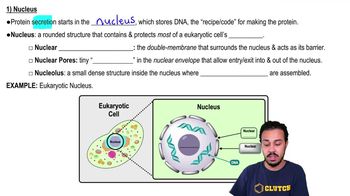
The vestibular nucleus is a group of neurons in the brainstem that processes sensory information related to balance and spatial orientation. It receives input from the inner ear's vestibular apparatus and helps coordinate eye movements and posture to maintain equilibrium.
Recommended video:
06:32
Nucleus

Role of the Vestibular System in Balance

The vestibular system detects head movements and position changes, sending signals to the brain to help maintain balance and posture. Damage to this system or its nuclei disrupts these signals, leading to dizziness, vertigo, and difficulty maintaining balance.
Recommended video:
11:30
Renin-Angiotensin-Aldosterone-System

Differentiation of Sensory and Motor Functions

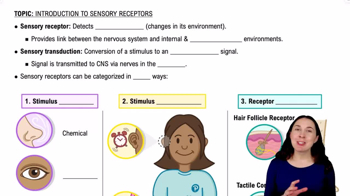
Understanding which brain regions control specific senses or motor functions is crucial. The vestibular nucleus is not involved in vision, hearing, pain sensation, or swallowing, so damage to it specifically affects balance rather than these other functions.
Recommended video:
2:47
Sensory Receptors