Ch. 12 Nervous Tissue
Martini - Fundamentals of Anatomy and Physiology 12th Edition
Martini, Nath, Bartholomew12th EditionFundamentals of Anatomy and PhysiologyISBN: 9780137854011Not the one you use?Change textbook
Chapter 12, Problem 17

Describe the steps involved in the generation of an action potential.

Verified step by step guidance
1
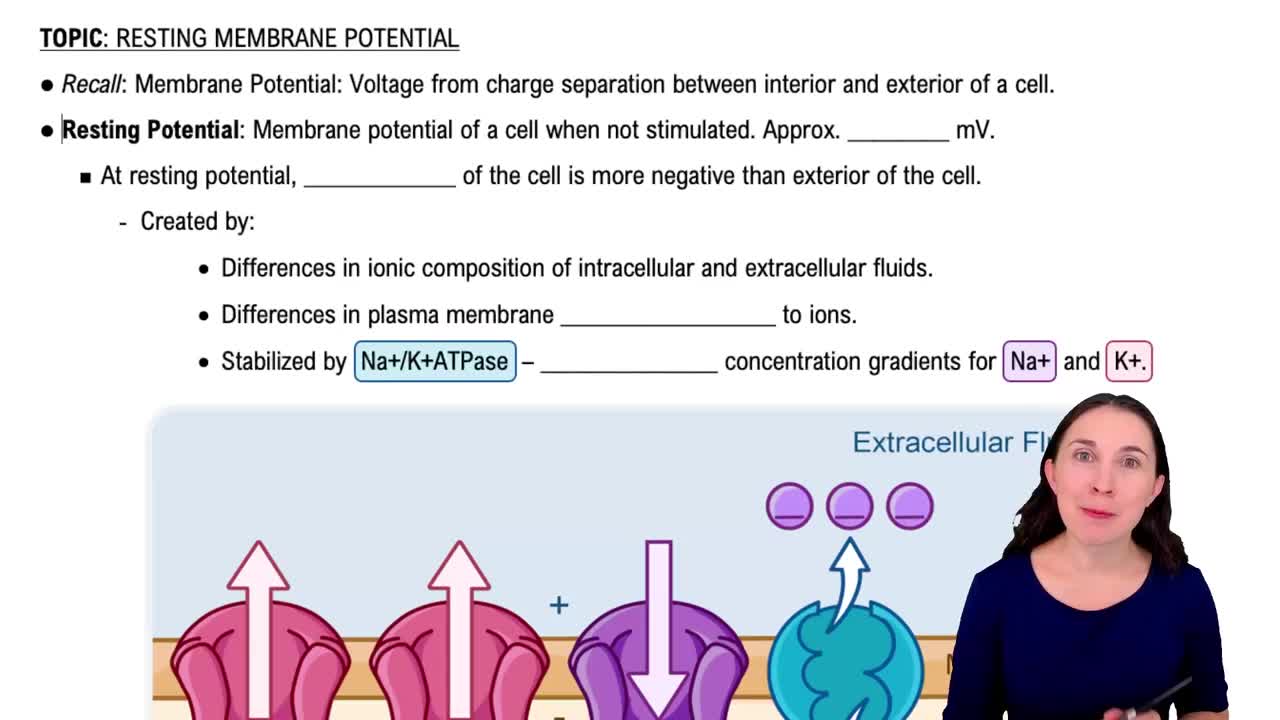
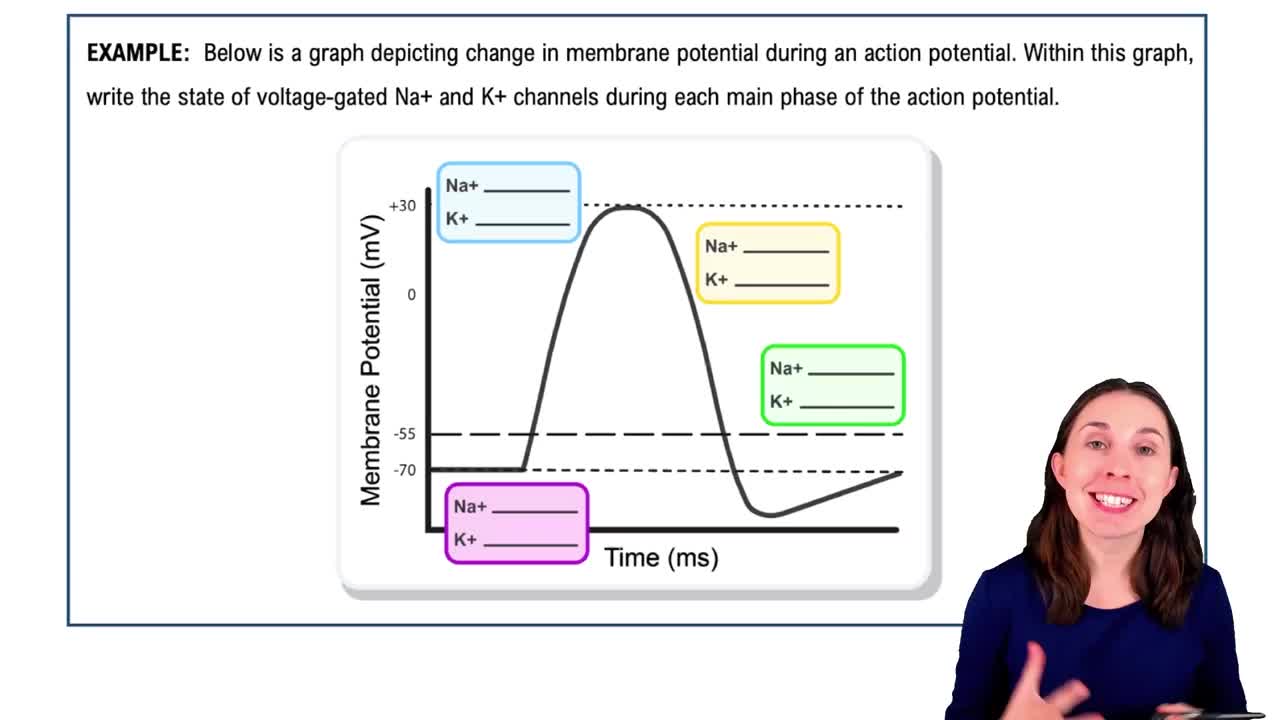
Step 1: Resting membrane potential is established, typically around -70 mV, due to the distribution of ions (mainly Na\(\textsuperscript{+}\) and K\(\textsuperscript{+}\)) across the neuron's membrane and the activity of the sodium-potassium pump.
Step 2: A stimulus causes the membrane potential to reach the threshold level (usually around -55 mV), triggering the opening of voltage-gated sodium (Na\(\textsuperscript{+}\)) channels.
Step 3: Rapid depolarization occurs as Na\(\textsuperscript{+}\) ions rush into the cell, making the inside of the neuron more positive.
Step 4: At the peak of the action potential, voltage-gated sodium channels close and voltage-gated potassium (K\(\textsuperscript{+}\)) channels open, allowing K\(\textsuperscript{+}\) ions to exit the cell, initiating repolarization.
Step 5: The membrane potential returns toward the resting level (repolarization), sometimes overshooting to cause hyperpolarization, before the sodium-potassium pump and leak channels restore the resting membrane potential.

Verified video answer for a similar problem:

This video solution was recommended by our tutors as helpful for the problem above.
Video duration:
5m
Was this helpful?

Key Concepts

Here are the essential concepts you must grasp in order to answer the question correctly.

Resting Membrane Potential

The resting membrane potential is the electrical charge difference across the neuron's membrane when it is not transmitting a signal, typically around -70 mV. It is maintained by ion gradients, primarily through the sodium-potassium pump and selective permeability to ions, setting the stage for action potential initiation.
Recommended video:
07:53
Resting Membrane Potential

Depolarization and Threshold

Depolarization occurs when a stimulus causes the membrane potential to become less negative, reaching a critical threshold (usually around -55 mV). This triggers voltage-gated sodium channels to open, allowing Na+ ions to rush into the cell, initiating the rising phase of the action potential.
Recommended video:
4:35
Transport Maximum (TM) & Renal Threshold

Repolarization and Hyperpolarization

After the peak of the action potential, voltage-gated sodium channels close and potassium channels open, allowing K+ to exit the cell, restoring the negative membrane potential (repolarization). Sometimes, the membrane potential becomes more negative than resting level (hyperpolarization) before stabilizing back to resting potential.
Recommended video:
02:36
Action Potentials Example 1