Ch. 11 The Muscular System
Martini - Fundamentals of Anatomy and Physiology 12th Edition
Martini, Nath, Bartholomew12th EditionFundamentals of Anatomy and PhysiologyISBN: 9780137854011Not the one you use?Change textbook
Chapter 11, Problem 29

Mary sees Jill coming toward her and immediately contracts her frontalis and procerus. She also contracts her right levator labii. Is Mary glad to see Jill? How can you tell?

Verified step by step guidance
1
Identify the muscles Mary contracts: the frontalis, procerus, and right levator labii. Each of these muscles contributes to specific facial expressions.
Understand the function of the frontalis muscle: it raises the eyebrows and wrinkles the forehead, often associated with surprise or concern rather than happiness.
Recognize the role of the procerus muscle: it pulls the skin between the eyebrows downward, creating a frown or furrowed brow, which is typically linked to anger or displeasure.
Consider the action of the levator labii muscle: it elevates the upper lip, which can indicate disdain, disgust, or contempt, especially when contracted unilaterally (on one side).
Combine these muscle actions to interpret Mary's emotional state: since the muscles involved are generally associated with negative or intense emotions rather than joy, it suggests Mary is not glad to see Jill.

Verified video answer for a similar problem:

This video solution was recommended by our tutors as helpful for the problem above.
Video duration:
3m
Was this helpful?

Key Concepts

Here are the essential concepts you must grasp in order to answer the question correctly.

Facial Expressions and Emotions

Facial expressions are key indicators of emotional states. The frontalis muscle raises the eyebrows, often associated with surprise or happiness, while the procerus can indicate frowning or concern. The levator labii elevates the upper lip, which can signal a positive emotional response. Understanding these expressions helps in interpreting Mary's feelings toward Jill.
Recommended video:
Guided course
6:30
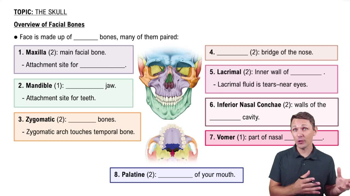
Overview of Facial Bones

Nonverbal Communication

Nonverbal communication encompasses all forms of communication that do not involve words, including facial expressions, body language, and gestures. It plays a crucial role in conveying emotions and intentions. In this scenario, Mary's facial muscle contractions serve as nonverbal cues that can suggest her emotional state and attitude toward Jill.
Recommended video:
2:59
Map of the Lesson on Cell Communication

Contextual Interpretation

Contextual interpretation involves analyzing the surrounding circumstances and environment to understand behavior and emotions accurately. In this case, the context of Mary seeing Jill and her immediate facial reactions provides insight into her feelings. Recognizing the social dynamics and previous interactions can further clarify whether her expressions indicate gladness or another emotion.
Recommended video:
2:48
Circuit Level & Perceptual Level