
Textbook Question
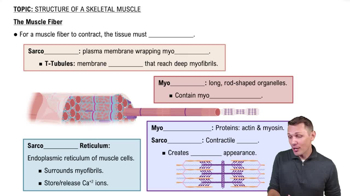
Areas of the body where you would not expect to find slow fibers include the
(a) Back and calf muscles
(b) Eye and hand
(c) Chest and abdomen
(d) All of these
1
views

 Verified step by step guidance
 7:47
7:47
 02:01
02:01 4:21
4:21Areas of the body where you would not expect to find slow fibers include the
(a) Back and calf muscles
(b) Eye and hand
(c) Chest and abdomen
(d) All of these
An action potential can travel quickly from one cardiac muscle cell to another because of the presence of
(a) Gap junctions
(b) Tight junctions
(c) Intercalated discs
(d) Both a and c
What forms of energy reserves do resting skeletal muscle fibers contain?
Which of the following statements about myofibrils is not correct?
(a) Each skeletal muscle fiber contains hundreds to thousands of myofibrils.
(b) Myofibrils contain repeating units called sarcomeres.
(c) Myofibrils extend the length of a skeletal muscle fiber.
(d) Filaments consist of bundles of myofibrils.
(e) Myofibrils are attached to the plasma membrane at both ends of a muscle fiber.
What is the calcium-binding protein in smooth muscle tissue?
What three layers of connective tissue are part of each muscle? What functional role does each layer play?