Ch. 1 An Introduction to Anatomy and Physiology
Martini - Fundamentals of Anatomy and Physiology 12th Edition
Martini, Nath, Bartholomew12th EditionFundamentals of Anatomy and PhysiologyISBN: 9780137854011Not the one you use?Change textbook
Chapter 1, Problem 22

Which body cavity would enclose each of the following organs?
(a) Heart
(b) Small intestine, large intestine
(c) Lung
(d) Kidneys

Verified step by step guidance
1
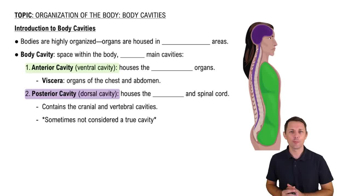
Identify the major body cavities in human anatomy: the dorsal cavity (which includes the cranial and vertebral cavities) and the ventral cavity (which includes the thoracic and abdominopelvic cavities).
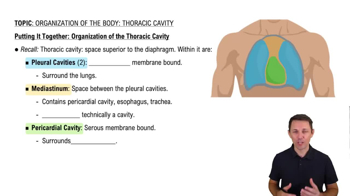
For the heart, determine which cavity it is located in by recalling that the heart is enclosed within the thoracic cavity, specifically in the mediastinum, the central compartment of the thoracic cavity.
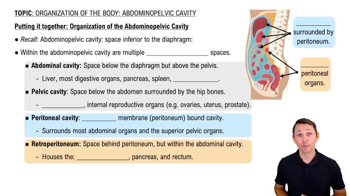
For the small and large intestines, recognize that these organs are part of the digestive system and are located within the abdominopelvic cavity, which is the lower portion of the ventral cavity.
For the lungs, note that they are located in the thoracic cavity, each lung enclosed within its own pleural cavity, which is a subdivision of the thoracic cavity.
For the kidneys, understand that they are located in the posterior part of the abdominopelvic cavity, specifically in the retroperitoneal space, which means they lie behind the peritoneal lining of the abdominal cavity.

Verified video answer for a similar problem:

This video solution was recommended by our tutors as helpful for the problem above.
Video duration:
2m
Was this helpful?

Key Concepts

Here are the essential concepts you must grasp in order to answer the question correctly.

Body Cavities

Body cavities are spaces within the body that house and protect internal organs. Major cavities include the dorsal cavity (cranial and spinal) and the ventral cavity, which is further divided into thoracic and abdominopelvic cavities. Understanding these cavities helps locate where organs are situated.
Recommended video:
Guided course
3:20
Introduction to Body Cavities

Thoracic Cavity and Its Subdivisions

The thoracic cavity is the upper part of the ventral cavity, enclosed by the rib cage. It contains the heart within the pericardial cavity and the lungs within the pleural cavities. Recognizing these subdivisions is essential to correctly assign organs like the heart and lungs.
Recommended video:
Guided course
2:51
Organization of the Thoracic Cavity

Abdominopelvic Cavity and Retroperitoneal Space

The abdominopelvic cavity houses digestive organs like the small and large intestines. Kidneys are located in the retroperitoneal space, behind the peritoneal lining. Differentiating these areas clarifies the placement of organs such as intestines and kidneys.
Recommended video:
Guided course
5:46
Organization of the Abdominopelvic Cavity