Ch. 1 An Introduction to Anatomy and Physiology
Martini - Fundamentals of Anatomy and Physiology 12th Edition
Martini, Nath, Bartholomew12th EditionFundamentals of Anatomy and PhysiologyISBN: 9780137854011Not the one you use?Change textbook
Chapter 1, Problem 14

Match each numbered item with the most closely related lettered item. Use letters for answers in the spaces provided.
_____Divides thoracic and abdominopelvic body cavities
a. Study of tissues 
b. Constant internal environment 
c. Face-up position 
d. Study of functions 
e. Positive feedback 
f. Organ system 
g. Study of cells 
h. Negative feedback 
i. Serous membrane 
j. Study of internal and external body structures 
k. Diaphragm 
l. Tissue 
m. Peritoneal cavity 
n. Organ 
o. Face-down position

Verified step by step guidance
1
Identify the key phrase in the question: 'Divides thoracic and abdominopelvic body cavities.' This refers to a structure that separates these two major body cavities.
Recall anatomical knowledge: The thoracic cavity is separated from the abdominopelvic cavity by a muscular structure known as the diaphragm.
Look through the provided lettered options to find the one that matches this structure. The option 'k. Diaphragm' corresponds to the muscle that divides these cavities.
Confirm that other options do not fit the description: for example, 'i. Serous membrane' refers to membranes lining cavities but does not divide them; 'm. Peritoneal cavity' is a specific cavity within the abdominopelvic region, not a dividing structure.
Therefore, the correct match for 'Divides thoracic and abdominopelvic body cavities' is 'k. Diaphragm.'

Verified video answer for a similar problem:

This video solution was recommended by our tutors as helpful for the problem above.
Video duration:
1m
Was this helpful?

Key Concepts

Here are the essential concepts you must grasp in order to answer the question correctly.

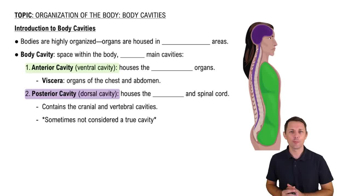
Body Cavities and Their Divisions

The human body is divided into major cavities, including the thoracic and abdominopelvic cavities. These cavities house vital organs and are separated by the diaphragm, a muscular partition. Understanding these divisions helps in locating organs and describing anatomical relationships.
Recommended video:
Guided course
3:20
Introduction to Body Cavities

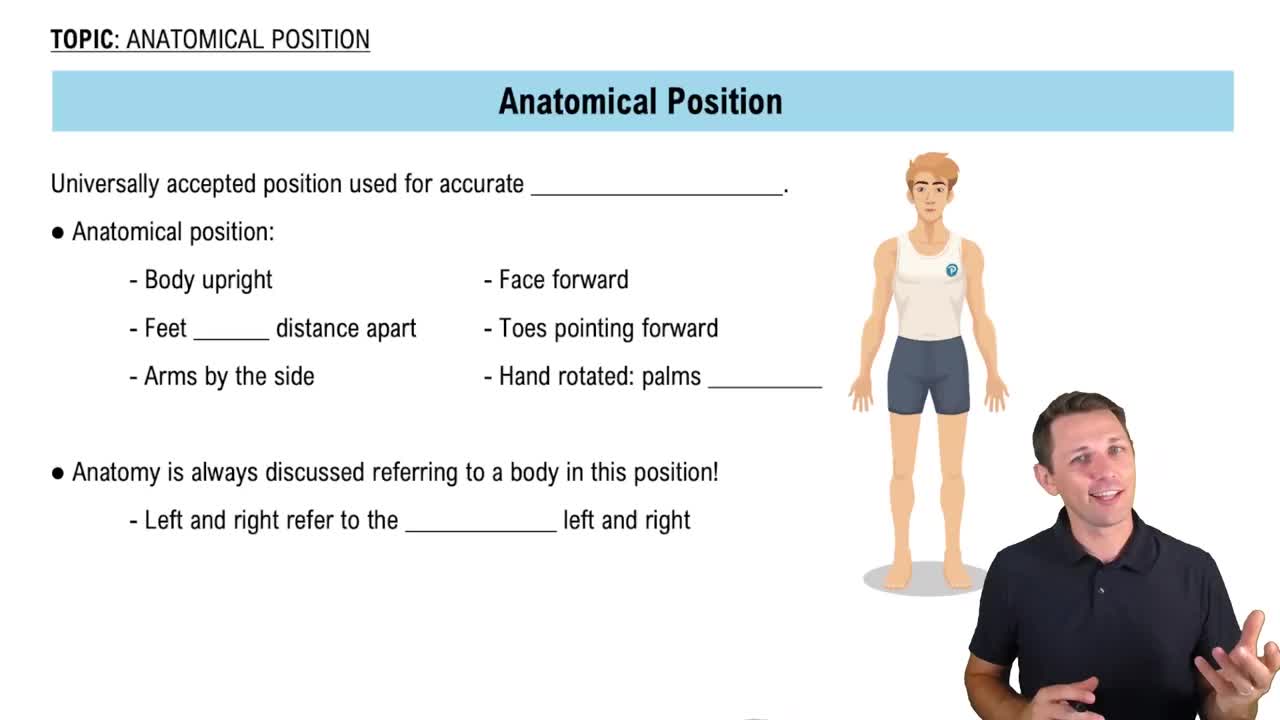
Anatomical Terminology and Positions

Anatomical terms describe body positions and orientations, such as face-up (supine) and face-down (prone). These terms provide a standardized way to describe locations and directions in the body, essential for clear communication in anatomy and physiology.
Recommended video:
Guided course
02:40
Anatomical Position

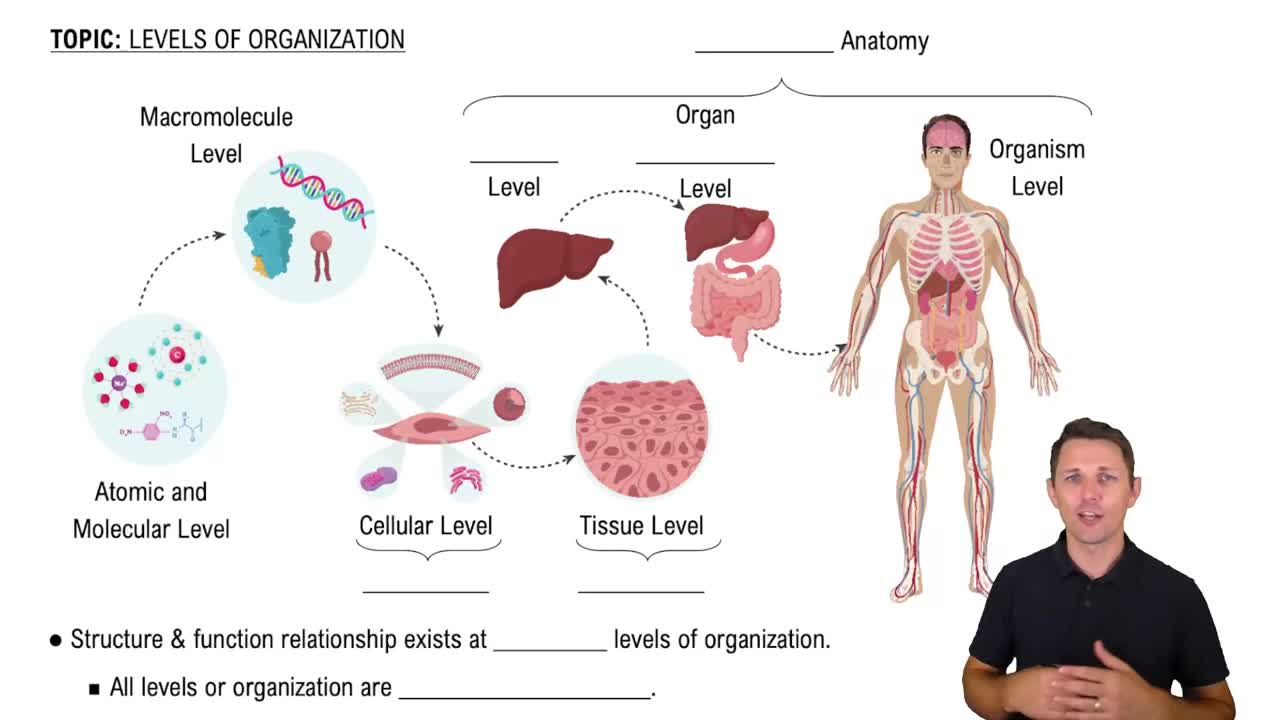
Levels of Structural Organization

The body is organized into levels from cells to tissues, organs, and organ systems. Recognizing these levels helps in understanding how structures relate and function together, such as how tissues form organs like the diaphragm that separate body cavities.
Recommended video:
Guided course
05:04
The Levels of Organization
Related Practice
Textbook Question

Match each numbered item with the most closely related lettered item. Use letters for answers in the spaces provided.

_____Abdominopelvic cavity

a. Study of tissues 

b. Constant internal environment 

c. Face-up position 

d. Study of functions 

e. Positive feedback 

f. Organ system 

g. Study of cells 

h. Negative feedback 

i. Serous membrane 

j. Study of internal and external body structures 

k. Diaphragm 

l. Tissue 

m. Peritoneal cavity 

n. Organ 

o. Face-down position

1
views
Textbook Question

The following is a list of six levels of organization that make up the human body:

(1) Tissue

(2) Cell

(3) Organ

(4) Chemical

(5) Organism

(6) Organ system

The correct order, from the simplest to the most complex level, is

(a) 2, 4, 1, 3, 6, 5

(b) 4, 2, 1, 3, 6, 5

(c) 4, 2, 1, 6, 3, 5

(d) 4, 2, 3, 1, 6, 5

(e) 2, 1, 4, 3, 5, 6

1
views
Textbook Question

Match each numbered item with the most closely related lettered item. Use letters for answers in the spaces provided.

_____Supine

a. Study of tissues 

b. Constant internal environment 

c. Face-up position 

d. Study of functions 

e. Positive feedback 

f. Organ system 

g. Study of cells 

h. Negative feedback 

i. Serous membrane 

j. Study of internal and external body structures 

k. Diaphragm 

l. Tissue 

m. Peritoneal cavity 

n. Organ 

o. Face-down position

Textbook Question

Match each numbered item with the most closely related lettered item. Use letters for answers in the spaces provided.

____Prone

a. Study of tissues 

b. Constant internal environment 

c. Face-up position 

d. Study of functions 

e. Positive feedback 

f. Organ system 

g. Study of cells 

h. Negative feedback 

i. Serous membrane 

j. Study of internal and external body structures 

k. Diaphragm 

l. Tissue 

m. Peritoneal cavity 

n. Organ 

o. Face-down position

1
views
Textbook Question

Match each numbered item with the most closely related lettered item. Use letters for answers in the spaces provided.

______Pericardium

a. Study of tissues 

b. Constant internal environment 

c. Face-up position 

d. Study of functions 

e. Positive feedback 

f. Organ system 

g. Study of cells 

h. Negative feedback 

i. Serous membrane 

j. Study of internal and external body structures 

k. Diaphragm 

l. Tissue 

m. Peritoneal cavity 

n. Organ 

o. Face-down position

1
views
Textbook Question

Match each numbered item with the most closely related lettered item. Use letters for answers in the spaces provided.

_____Labor and delivery

a. Study of tissues 

b. Constant internal environment 

c. Face-up position 

d. Study of functions 

e. Positive feedback 

f. Organ system 

g. Study of cells 

h. Negative feedback 

i. Serous membrane 

j. Study of internal and external body structures 

k. Diaphragm 

l. Tissue 

m. Peritoneal cavity 

n. Organ 

o. Face-down position

1
views