Ch. 8 The Appendicular Skeleton
Martini - Fundamentals of Anatomy & Physiology 11th Edition
Martini, Nath, Bartholomew11th EditionFundamentals of Anatomy & PhysiologyISBN: 9780136874089Not the one you use?Change textbook
Chapter 8, Problem 12

At the glenoid cavity, the scapula articulates with the proximal end of the (a) humerus, (b) radius, (c) ulna, (d) femur.

Verified step by step guidance
1
Step 1: Understand the anatomy of the shoulder joint, specifically the glenoid cavity, which is a part of the scapula (shoulder blade).
Step 2: Recall that the glenoid cavity is a shallow socket that forms the socket part of the ball-and-socket joint of the shoulder.
Step 3: Identify the bone that fits into this socket to form the shoulder joint. This bone must have a proximal end shaped like a ball to fit into the glenoid cavity.
Step 4: Review the options: (a) humerus, (b) radius, (c) ulna, (d) femur. Consider which of these bones is located in the upper arm and has a proximal end that articulates with the scapula.
Step 5: Conclude that the humerus is the bone that articulates with the glenoid cavity of the scapula, forming the shoulder joint.

Verified video answer for a similar problem:

This video solution was recommended by our tutors as helpful for the problem above.
Video duration:
2m
Was this helpful?

Key Concepts

Here are the essential concepts you must grasp in order to answer the question correctly.

Glenoid Cavity

The glenoid cavity is a shallow, articular depression on the lateral aspect of the scapula. It serves as the socket for the ball-and-socket joint of the shoulder, allowing articulation with the head of the humerus. Understanding its location and function is key to identifying the correct bone it connects with.
Recommended video:
Guided course
2:51
Organization of the Thoracic Cavity

Humerus Anatomy

The humerus is the long bone of the upper arm, with a rounded head that fits into the glenoid cavity of the scapula. This articulation forms the shoulder joint, enabling a wide range of arm movements. Recognizing the humerus as the proximal bone of the arm is essential for answering the question.
Recommended video:
4:14
Clitoral Anatomy

Articulation and Joint Types

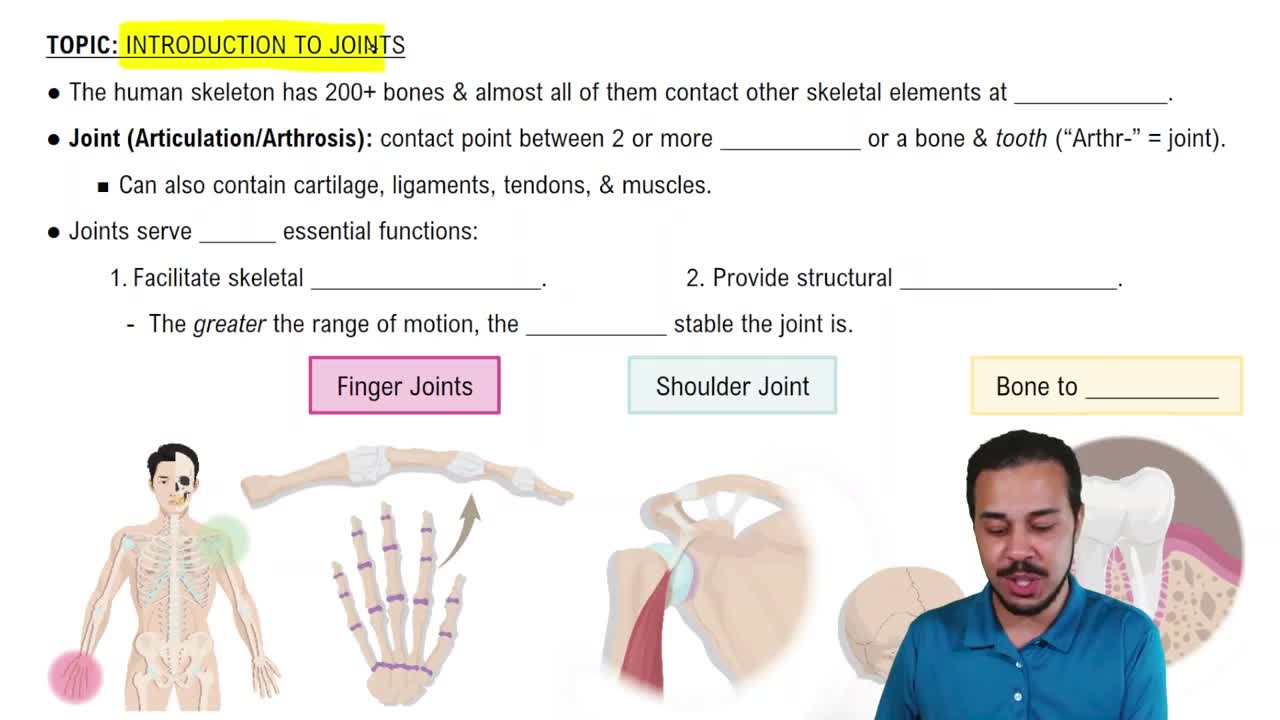
Articulation refers to the connection between bones at a joint. The shoulder joint is a ball-and-socket joint, characterized by the humeral head fitting into the glenoid cavity. Knowing joint types helps in understanding which bones connect and how they move relative to each other.
Recommended video:
05:39
Introduction to Joints