Ch. 7 The Axial Skeleton
Martini - Fundamentals of Anatomy & Physiology 11th Edition
Martini, Nath, Bartholomew11th EditionFundamentals of Anatomy & PhysiologyISBN: 9780136874089Not the one you use?Change textbook
Chapter 7, Problem 7

or each of the following vertebrae, indicate its vertebral region. a. ____ b. ____ c. ____

Verified step by step guidance
1
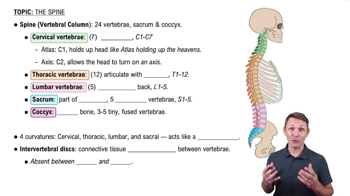
Step 1: Understand the vertebral column is divided into five main regions: cervical, thoracic, lumbar, sacral, and coccygeal. Each vertebra belongs to one of these regions based on its location.
Step 2: Identify the characteristics of each vertebral region to help classify the vertebrae. For example, cervical vertebrae are in the neck and typically have small bodies and transverse foramina; thoracic vertebrae have facets for rib articulation; lumbar vertebrae are larger and support more weight; sacral vertebrae are fused to form the sacrum; coccygeal vertebrae form the tailbone.
Step 3: For each vertebra given (a, b, c), examine any provided features or labels to determine which region it belongs to. If the vertebrae are named (e.g., C3, T7, L2), use the letter prefix to identify the region: C for cervical, T for thoracic, L for lumbar, S for sacral, and Co for coccygeal.
Step 4: Assign the vertebral region to each vertebra based on your identification. For example, if a vertebra is labeled T5, it belongs to the thoracic region.
Step 5: Review your answers to ensure each vertebra is matched correctly with its vertebral region, considering both anatomical location and distinguishing features.

Verified video answer for a similar problem:

This video solution was recommended by our tutors as helpful for the problem above.
Was this helpful?

Key Concepts

Here are the essential concepts you must grasp in order to answer the question correctly.

Vertebral Regions

The vertebral column is divided into distinct regions: cervical, thoracic, lumbar, sacral, and coccygeal. Each region has characteristic vertebrae that differ in size, shape, and function, which helps in identifying the region to which a vertebra belongs.
Recommended video:
Guided course
04:21
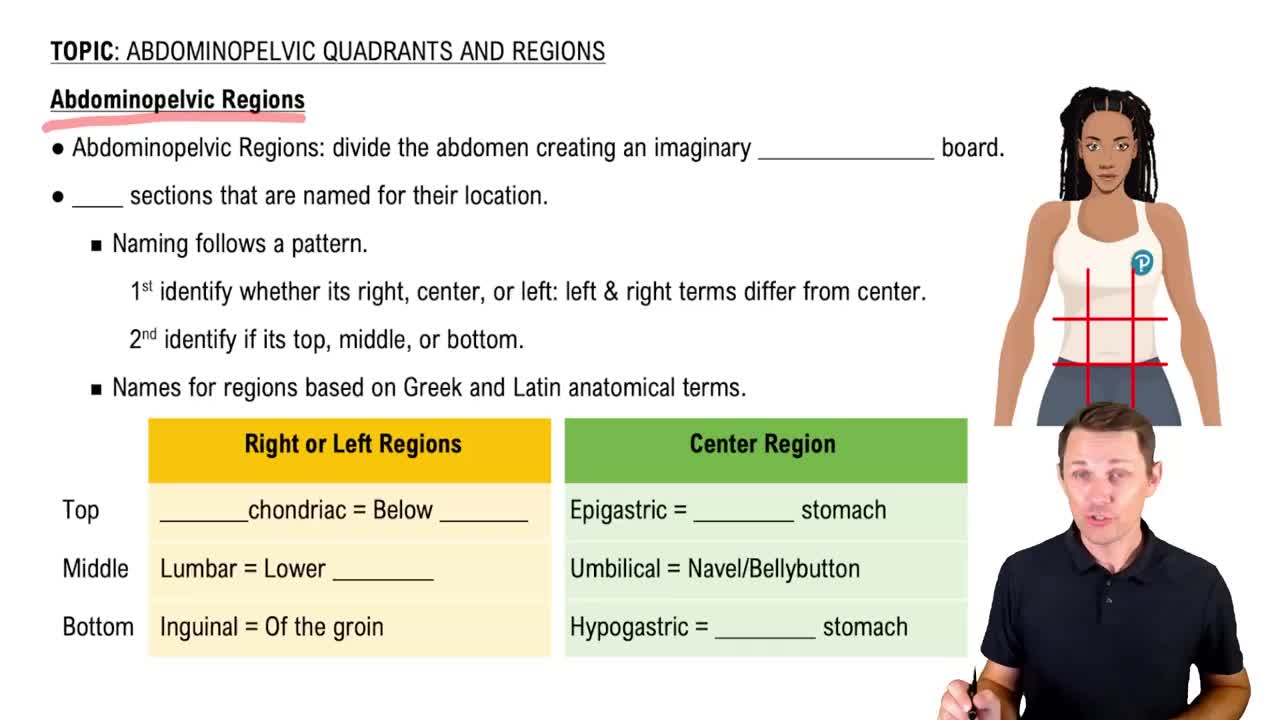
The 9 Abdominopelvic Regions

Anatomical Features of Vertebrae

Each vertebra has specific anatomical features such as the shape of the vertebral body, size and orientation of spinous and transverse processes, and presence of facets. Recognizing these features is essential to classify a vertebra into its correct region.
Recommended video:
Guided course
02:33
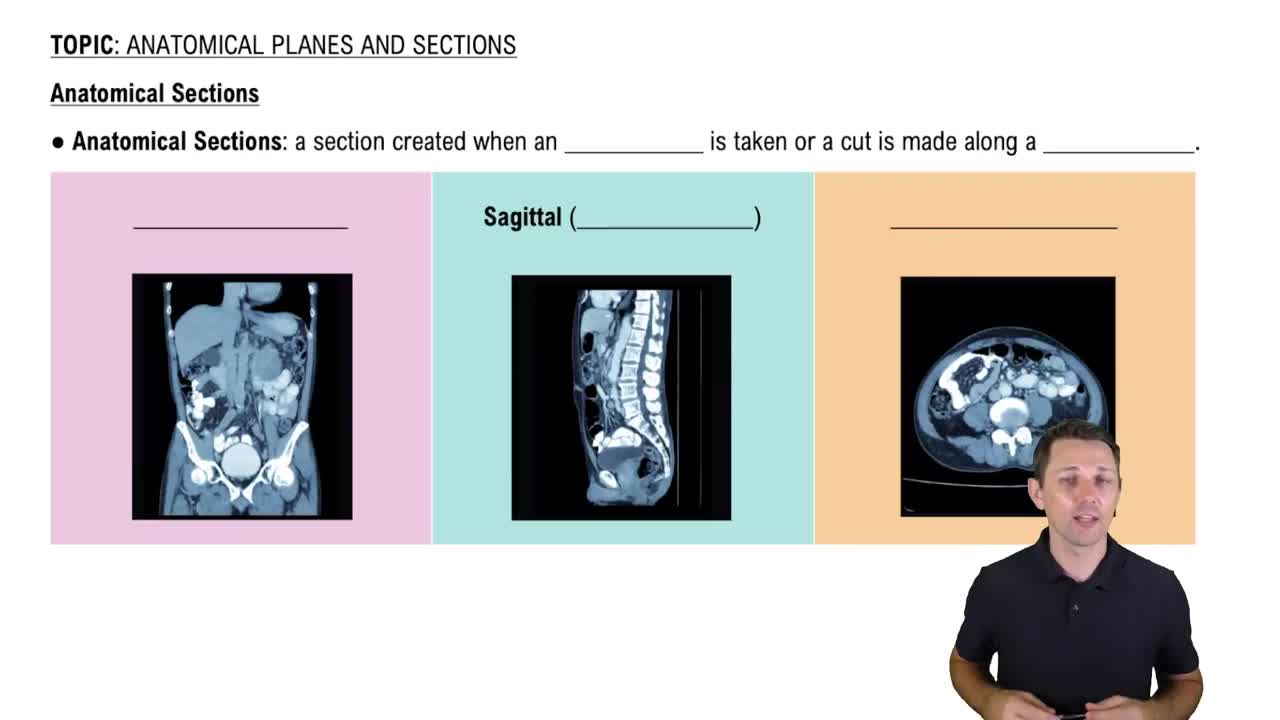
Anatomical Sections

Vertebral Numbering and Identification

Vertebrae are numbered sequentially within each region (e.g., C1-C7 for cervical). Understanding this numbering system and the unique traits of vertebrae at different levels aids in accurately identifying the vertebral region for a given vertebra.
Recommended video:
Guided course
6:29
Spine (Vertebral Column)