Ch. 6 Bones and Bone Structure
Martini - Fundamentals of Anatomy & Physiology 11th Edition
Martini, Nath, Bartholomew11th EditionFundamentals of Anatomy & PhysiologyISBN: 9780136874089Not the one you use?Change textbook
Chapter 6, Problem 1

Blood cell formation occurs in:
(a) Yellow bone marrow
(b) Red bone marrow
(c) The matrix of bone tissue
(d) The ground substance of bones

Verified step by step guidance
1
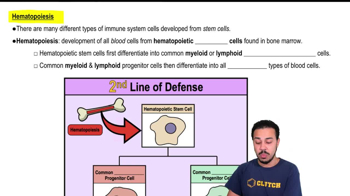
Understand that blood cell formation is also known as hematopoiesis, which is the process of producing new blood cells.
Recall that hematopoiesis primarily occurs in a specific type of bone marrow, which is responsible for generating red blood cells, white blood cells, and platelets.
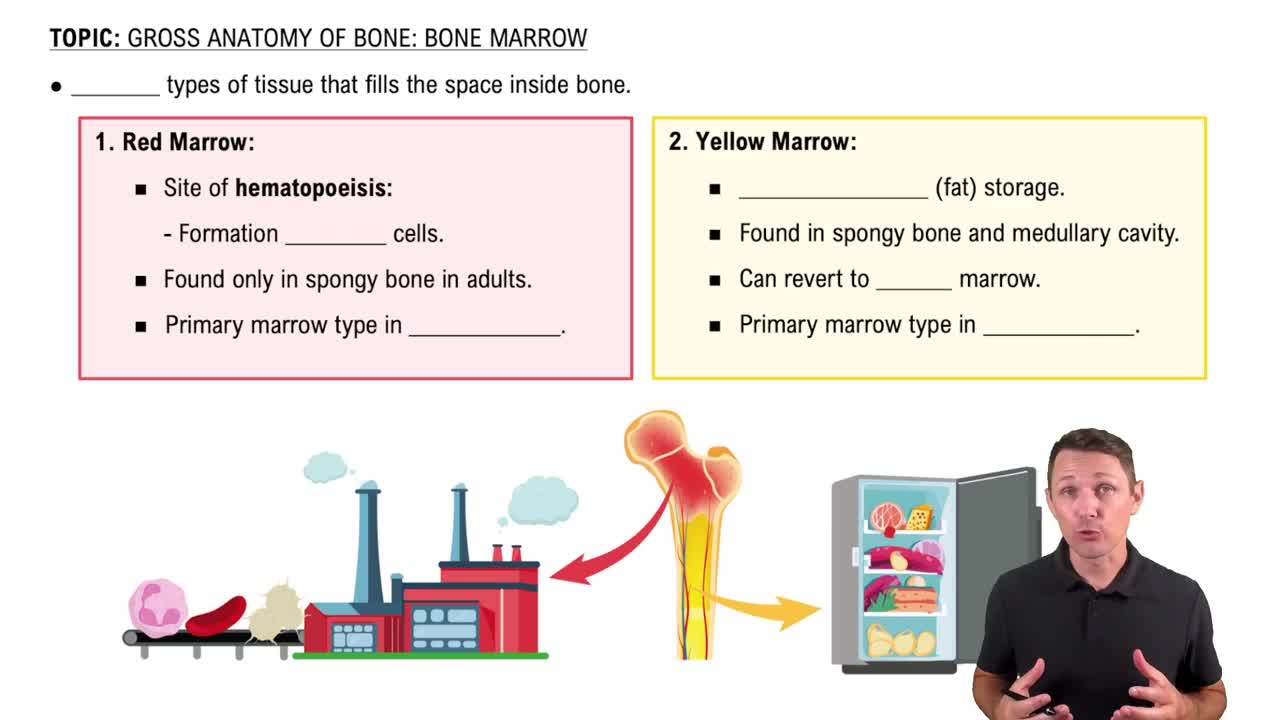
Identify the two types of bone marrow: yellow bone marrow, which mainly stores fat, and red bone marrow, which is actively involved in blood cell production.
Eliminate options that refer to bone matrix and ground substance, as these are structural components of bone tissue and do not participate in blood cell formation.
Conclude that the correct site of blood cell formation is the red bone marrow, where hematopoietic stem cells reside and differentiate into various blood cells.

Verified video answer for a similar problem:

This video solution was recommended by our tutors as helpful for the problem above.
Video duration:
2m
Was this helpful?

Key Concepts

Here are the essential concepts you must grasp in order to answer the question correctly.

Hematopoiesis

Hematopoiesis is the process of blood cell formation, including red blood cells, white blood cells, and platelets. It primarily occurs in specific tissues where stem cells differentiate into various blood cell types.
Recommended video:
2:33
Hematopoeisis

Red Bone Marrow

Red bone marrow is the active site of hematopoiesis in adults. It contains hematopoietic stem cells that produce all types of blood cells and is found mainly in flat bones and the ends of long bones.
Recommended video:

Yellow Bone Marrow

Yellow bone marrow mainly consists of fat cells and serves as an energy reserve. Unlike red marrow, it is not involved in blood cell production but can convert back to red marrow under certain conditions.
Recommended video: