Ch. 4 The Tissue Level of Organization
Martini - Fundamentals of Anatomy & Physiology 11th Edition
Martini, Nath, Bartholomew11th EditionFundamentals of Anatomy & PhysiologyISBN: 9780136874089Not the one you use?Change textbook
Chapter 4, Problem 15

Axons, dendrites, and a cell body are characteristic of cells located in
(a) Nervous tissue
(b) Muscle tissue
(c) Connective tissue
(d) Epithelial tissue

Verified step by step guidance
1
Step 1: Understand the components mentioned in the problem: axons, dendrites, and a cell body. These are structural features of certain types of cells.
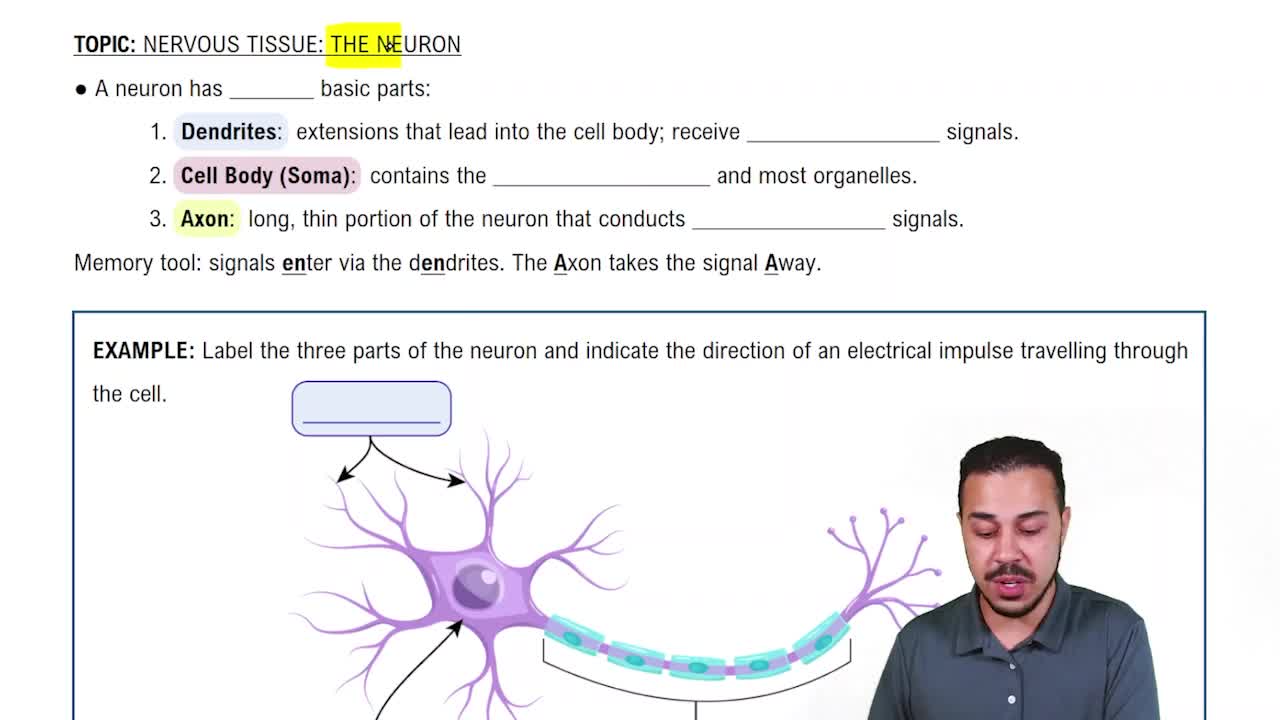
Step 2: Recall that axons and dendrites are extensions of neurons, which are the primary cells of nervous tissue. The cell body (soma) contains the nucleus and organelles of the neuron.
Step 3: Review the characteristics of the other tissue types: muscle tissue is composed of muscle fibers, connective tissue contains cells like fibroblasts and extracellular matrix, and epithelial tissue consists of tightly packed cells forming layers.
Step 4: Recognize that only nervous tissue contains cells with axons, dendrites, and a cell body, which are essential for transmitting electrical signals.
Step 5: Conclude that the correct answer is nervous tissue, as it uniquely features cells with axons, dendrites, and a cell body.

Verified video answer for a similar problem:

This video solution was recommended by our tutors as helpful for the problem above.
Was this helpful?

Key Concepts

Here are the essential concepts you must grasp in order to answer the question correctly.

Neurons and Nervous Tissue

Neurons are specialized cells in nervous tissue responsible for transmitting electrical signals. They have unique structures such as axons, dendrites, and a cell body that facilitate communication within the nervous system.
Recommended video:

Axons and Dendrites

Axons are long projections that carry impulses away from the neuron's cell body, while dendrites are branched extensions that receive signals from other neurons. Together, they enable the transmission and reception of nerve impulses.
Recommended video:

Tissue Types in the Body

The body has four main tissue types: nervous, muscle, connective, and epithelial. Each has distinct cell structures and functions; for example, muscle tissue contracts, connective tissue supports, and epithelial tissue covers surfaces.
Recommended video:
Guided course
00:36
3 Types of Muscle Tissue