Ch. 3 The Cellular Level of Organization
Martini - Fundamentals of Anatomy & Physiology 11th Edition
Martini, Nath, Bartholomew11th EditionFundamentals of Anatomy & PhysiologyISBN: 9780136874089Not the one you use?Change textbook
Chapter 3, Problem 2

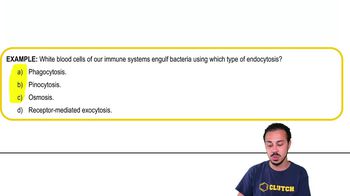
The process that transports solid objects such as bacteria into the cell is called
(a) Pinocytosis
(b) Phagocytosis
(c) Exocytosis
(d) Receptor-mediated endocytosis
(e) Channel-mediated transport

Verified step by step guidance
1
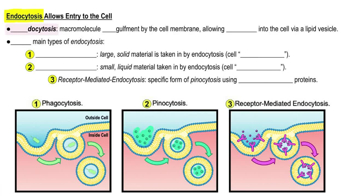
Step 1: Understand the key terms related to cellular transport mechanisms. Pinocytosis is the process of engulfing liquids or dissolved substances, often called 'cell drinking.'
Step 2: Recognize that phagocytosis is the process by which cells engulf solid particles, such as bacteria or cellular debris, often referred to as 'cell eating.'
Step 3: Exocytosis is the process of expelling materials from the cell, the opposite of endocytosis, so it does not involve intake of solids.
Step 4: Receptor-mediated endocytosis is a selective form of endocytosis where specific molecules bind to receptors before being internalized, but it is generally for specific molecules, not large solid objects like bacteria.
Step 5: Channel-mediated transport involves movement of substances through protein channels in the membrane, typically for ions or small molecules, not solid particles.

Verified video answer for a similar problem:

This video solution was recommended by our tutors as helpful for the problem above.
Video duration:
2m
Was this helpful?

Key Concepts

Here are the essential concepts you must grasp in order to answer the question correctly.

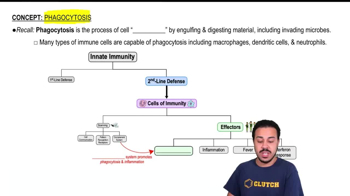
Phagocytosis

Phagocytosis is a cellular process where the cell engulfs large solid particles, such as bacteria or debris, by enclosing them in a vesicle called a phagosome. This is a form of endocytosis specifically for solid materials and is crucial for immune defense and cellular cleanup.
Recommended video:
2:19
Phagocytosis

Pinocytosis

Pinocytosis is a type of endocytosis where the cell ingests extracellular fluid and dissolved solutes by forming small vesicles. Unlike phagocytosis, it involves the uptake of liquids rather than solid particles, and it helps cells sample their environment.
Recommended video:
04:17
Endocytosis Allows Entry to the Cell

Receptor-mediated Endocytosis

Receptor-mediated endocytosis is a selective process where cells internalize specific molecules bound to receptors on the cell surface. This mechanism uses coated pits to form vesicles and is important for nutrient uptake and regulation of signaling molecules.
Recommended video:
01:52
Endocytosis and Exocytosis Example 1